
Your board just approved $500K for AI.
Leadership expects results. Engineering wants to explore. And your timeline? “Show us ROI in Q2.”
Here’s the problem:
Most AI projects take 12-18 months to show measurable AI ROI. By then, budgets are cut. Teams are reassigned. And your AI initiative becomes another “failed transformation.”
But it doesn’t have to be this way.
The difference between fast AI ROI and “still waiting for results” isn’t technology. It’s a strategy.
In this guide, you’ll learn the 4-step framework companies use to achieve measurable AI ROI in 90 days, see a real case study with actual numbers, and get the metrics to prove your AI project is working.
Let’s start with why most AI projects fail to deliver ROI.
Why Most AI Projects Take 18 Months (And Fail Anyway)
The average AI project timeline: 3 months planning, 6 months building, 6 months testing, 3 months deployment = 18 months before ROI.
The result? Only 35% of AI projects reach production (Gartner). Of those, 70% fail to deliver expected ROI in year one.
The 3 Mistakes That Kill AI ROI
Mistake 1: Starting with the Hardest Problem – Teams pick complex, highest-value problems first.
Result: 12+ months before seeing value.
Mistake 2: No Clear ROI Metrics Upfront – “Increase efficiency” isn’t measurable.
Result: Can’t prove ROI even when AI works.
Mistake 3: Building Everything from Scratch – Custom data pipelines, proprietary models, everything in-house.
Result: years of engineering before value.
Better approach: Start simple, define metrics upfront, and use vendor solutions where possible.
The Fast AI ROI Framework: 4 Steps to Results in 90 Days
Here’s how companies achieve measurable AI ROI in one quarter instead of 18 months.
Step 1: Pick the Right First Use Case (Week 1-2)
The ideal first use case has 4 characteristics:
- High Frequency: Task happens daily or weekly
- Clear Baseline: You can measure current performance
- Existing Data: Data already exists in your systems
- Low Risk: Mistakes are annoying but not catastrophic
Fast ROI Use Cases:
| Use Case | ROI Timeline | Why It’s Fast |
|---|---|---|
| Support ticket routing | 2–4 weeks | High frequency, clear metrics, existing data |
| Sales email generation | 3–6 weeks | High volume, measurable outcomes, low risk |
| Document data extraction | 4–8 weeks | Existing docs, immediate time savings |
| Lead scoring | 4–8 weeks | Existing CRM data, clear business impact |
Avoid for first project: Autonomous decision-making, real-time fraud detection, complex multi-system integration.
How to choose: List 5 manual tasks your team does weekly. Pick the one that takes the most total time and has data already in your systems.
Example: A financial services company chose automated client onboarding (8 weeks) over AI trading algorithms (18+ months). Showed ROI in 60 days, used savings to fund the complex project.
Timeline: 1-2 weeks to evaluate and pick.
Step 2: Define ROI Metrics Before You Build (Week 2-3)
You can’t prove ROI if you don’t define it upfront.
The Fast ROI Metrics Framework:
Primary Metric: Cost savings ($/month), revenue increase ($/month), or time savings (hours x hourly cost)
Secondary Metrics: Accuracy (% correct), adoption (% using AI), processing speed (AI vs manual time)
Leading Indicators: User satisfaction (thumbs up/down), task completion rate, cost per transaction
AI ROI Calculation Example
Use case: Automated support ticket routing 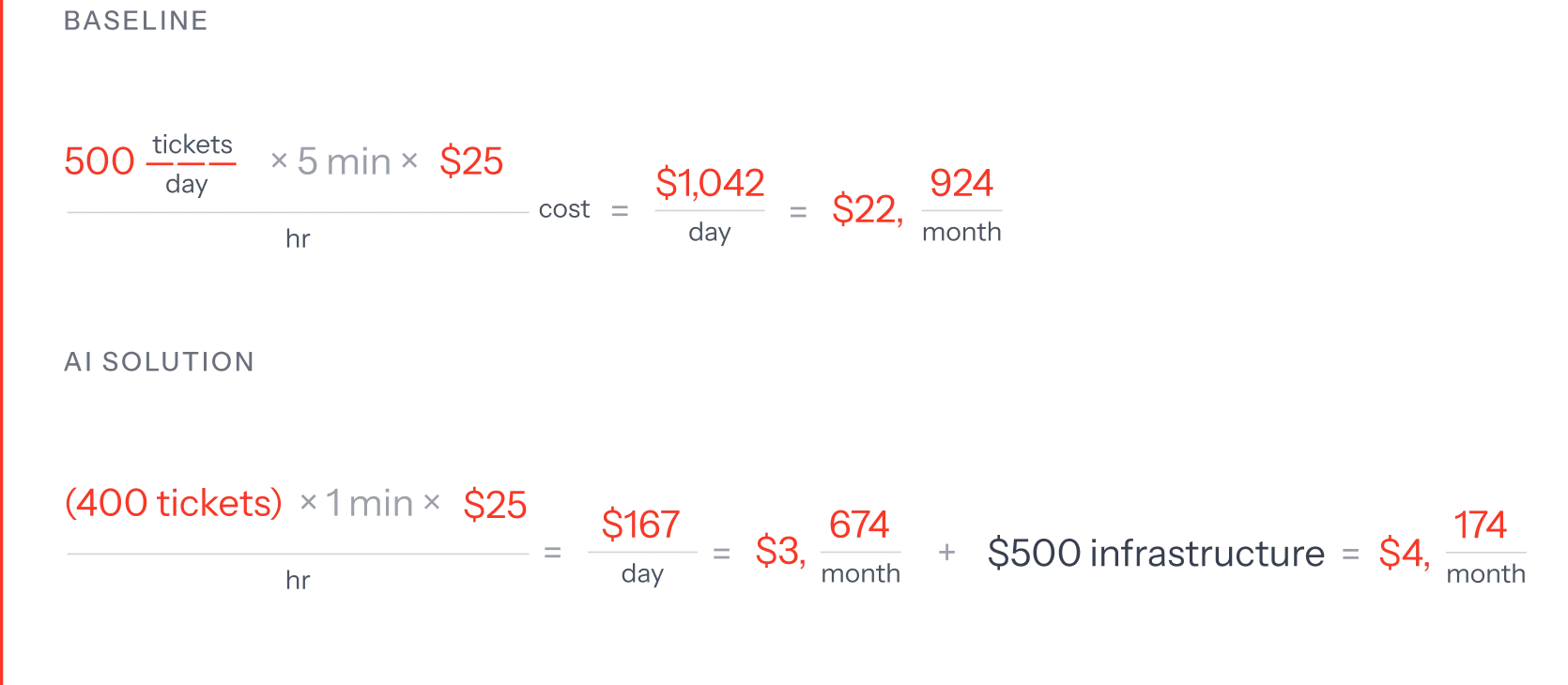 ROI:
ROI:
- Monthly savings: $18,750
- Annual savings: $225,000
- Implementation cost: $50,000
- Payback period:7 months
- First-year ROI: 350%
Use an AI ROI calculator approach:
- Current process cost (time x people x hourly rate)
- Target AI automation % (realistic, not 100%)
- Remaining human oversight cost
- AI infrastructure + API costs
- Implementation cost
Timeline: 1 week to define metrics.
Step 3: Build Minimum Viable AI (Week 3-8)
Don’t build perfect AI. Build AI that shows ROI fastest.
Minimum Viable AI principles:
- Start with vendor solutions (OpenAI, Claude, Azure AI)
- Accept 70-80% accuracy with human review
- Leverage existing data infrastructure
- Ship to 10% of users first, then scale
- Build guardrails, not perfection
- What to Build in Weeks 3-8
What to Build in Weeks 3-8
Week 3-4: Connect to data, call AI API, validate outputs on 100 test cases
Week 5-6: Add validation, quality checks, human review workflow, deploy to 10 pilot users
Week 7-8: Scale to 50% of team, monitor performance, fix top 3 errors
Timeline: 5-6 weeks with 2 engineers.
Step 4: Measure, Optimize, Scale (Week 9-12)
Week 9-10: Compare actual results against targets from Step 2.
Week 11-12: Optimize areas below target (improve prompts, add examples, refine guardrails). Scale areas exceeding target (reduce human review, increase automation).
Calculate ROI After 90 Days:
Using ticket routing example:
- Actual monthly savings: $15,000
- Quarterly savings: $45,000
- Implementation cost: $50,000
- Projected annual ROI: $180K – $50K = $130K (260% ROI)
Present to leadership:
- Deployed in 8 weeks
- Automated 75% of target task
- Saving $15K/month ($180K/year)
- Payback in 3.3 months.
Timeline: 3-4 weeks to measure, optimize, and prove ROI.
90-Day Case Study: Healthcare Provider Automates Prior Authorization
The Challenge
Mid-sized healthcare provider processed 2,000 prior authorizations/month. Each took 45 minutes of clinical admin time at $35/hour.
Monthly cost: 1,500 hours x $35 = $52,500/month
The 90-Day Solution
Week 1-2: Chose prior authorization over 3 other options (highest frequency, clear metrics, existing EHR data, low risk)
Week 2-3: Defined ROI target – reduce manual time by 60%, save $31,500/month
Week 3-8: Built a custom AI solution using GPT-4 + RAG for insurance policies, integrated with EHR via FHIR API
Week 9-12: Measured results
| Metric | Baseline | Target | Actual |
|---|---|---|---|
| Time per auth | 45 min | 18 min | 22 min |
| Monthly cost | $52,500 | $21,000 | $27,300 |
| Accuracy | 72% | 85% | 88% |
| Staff adoption | 0% | 80% | 92% |
Financial results:
- Monthly savings: $25,200
- Implementation cost: $65,000
- Payback period: 2.6 months
- First-year ROI: 367%
Why This Worked
Realistic targets (60% reduction, not 100%), human-in-the-loop, pilot with 5 users first, tracked time savings from day one.
How to Measure AI ROI: Metrics by Use Case
| Use Case | Primary Metrics | Typical Results |
|---|---|---|
| AI Chatbot | Cost per ticket, % handled by AI, CSAT | 30–50% cost reduction, 2–3× faster response |
| Conversational AI | Automation rate, task completion, time saved | 40–60% tasks automated, 15–25% CSAT improvement |
| Document Processing | Time savings, error rate | 60–80% time savings, 2–4 months payback |
| Email Automation | Emails sent, response rates | 40–60% time savings, 3–6 months payback |
| Data Entry | Accuracy, processing speed | 70–90% time savings, 2–3 months payback |
Agentic AI ROI: Higher implementation cost (12-16 weeks vs 6-8), unpredictable behavior requires testing, typically 6-9 months payback. Start simple, prove ROI, then add autonomous capabilities.
3 Mistakes That Kill AI ROI
Mistake 1: No Baseline Measurement – Can’t prove savings if you never measured current cost.
Fix: Measure time per task, cost per task, and quality metrics BEFORE building.
Mistake 2: Optimizing for 100% Accuracy – Spending 6 months getting from 85% to 95% accuracy delays ROI by 6 months.
Ship at 75-80% with human review. 80% accuracy in 6 weeks beats 95% accuracy in 6 months.
Mistake 3: Building Without Data Engineering Foundation – AI team builds model, but data is in 5 systems with inconsistent formats. Integration takes 4 extra months.
Fix: Data readiness audit (1-2 weeks) prevents months of delays.
How Pendoah Accelerates AI ROI
Fast AI ROI requires both AI expertise and practical implementation experience. Pendoah delivers AI projects that show measurable returns in 90 days.
AI ROI Strategy (Week 1-2): Evaluate use cases, calculate expected ROI for each, recommend optimal first project, define success metrics, and create a 90-day roadmap.
Rapid Implementation (Week 3-10): Through AI staff augmentation and custom AI development, we provide ML engineers, data engineers, full-stack developers, and MLOps specialists who ship in 6-8 weeks.
Post-Launch Optimization (Week 11+): Measure actual ROI vs projections, optimize prompts to reduce costs, scale from pilot to full deployment.
Ready to Achieve Fast AI ROI?
The difference between fast AI ROI and “still waiting for results” is strategy.
The 4-step framework:
- Pick a high-frequency, low-risk use case with existing data
- Define ROI metrics before building
- Ship minimum viable AI in 6-8 weeks
- Measure, optimize, scale in 90 days
Most companies spend 18 months on AI projects that never see production. The alternative is shipping in 90 days and using savings to fund the next project.
Start with an AI ROI Assessment
Schedule Your Free AI ROI Consultation
In 45 minutes, we’ll:
- Evaluate 3-5 potential AI use cases
- Calculate projected ROI for each
- Recommend optimal first project
- Estimate 90-day implementation timeline
Or Get a Comprehensive AI Strategy
Request Free AI Opportunity Assessment
We’ll:
- Analyze your operations for AI opportunities
- Calculate potential ROI by use case
- Assess data and infrastructure readiness
- Create prioritized AI roadmap
The Future of AI ROI
The industry is shifting from “AI for AI’s sake” toward AI ROI accountability.
Forward-thinking companies recognize:
- Fast ROI beats perfect AI – Ship in weeks, optimize for months
- Start simple, scale smart – Prove value before big bets
- Measure constantly – ROI metrics from day one
- Human + AI wins – 80% automation with human review beats 100% automation in 18 months
The best AI projects aren’t the most technically impressive. They’re the ones that show measurable business impact in 90 days.
Pick the right use case. Define ROI upfront. Ship fast. Measures constantly.