Staff augmentation is a workforce model where organizations add external specialists to internal teams to expand capacity, fill talent gaps, or accelerate strategic initiatives. These external experts fully integrate into the organization’s workflows, processes, and culture. They operate like in-house teammates, but without the delays, commitments, and overhead of traditional hiring.
This creates a hybrid workforce structure. Some team members are full-time. Some are augmented. All operate as a unified team. Enterprises now prefer this hybrid model because:
- It removes geographic limitations
- It gives instant access to skills they cannot hire quickly
- It improves delivery predictability
- It reduces hiring costs and time
- It preserves control over intellectual property and roadmaps
Traditional hiring environments cannot compete with this level of flexibility and speed.
Why the Hybrid Workforce Outperforms Traditional Hiring
Below is a detailed comparison that shows why enterprises are shifting aggressively toward staff augmentation.
Traditional Hiring vs Staff Augmentation vs Outsourcing
Staff augmentation does not replace hiring or outsourcing. It sits between them. It creates the perfect balance for modern organizations.
| Factor | Traditional Hiring | Staff Augmentation | Outsourcing |
|---|---|---|---|
| Time to start | 60–180 days | 2–10 days | 30–90 days |
| Cost | High salaries + overhead | Predictable & optimized | Variable + vendor margin |
| Control | Full control | Full control | Limited control |
| Flexibility | Low | Very high | Moderate |
| Skill variety | Local talent only | Global pool + niche skills | Broad skill pool |
| Integration with internal teams | High | High | Low |
| Scalability | Slow | Fast | Moderate |
| Risk | High employment risk | Low employment risk | High dependency risk |
Benefits of Staff Augmentation: Why Companies Choose This Model?
Here are the top 6 benefits of staff augmentation for enterprises.
Faster Scaling Than Traditional Hiring
Hiring a senior developer, designer, or cloud engineer takes months. Staff augmentation allows companies to scale in days, not months. This happens because the provider already has access to vetted, specialized, and ready-to-deploy professionals.
This is extremely valuable for teams that need to:
- Accelerate product development
- Modernize backend systems
- Expand cloud, DevOps, or AIOps capabilities
- Strengthen mobile or front-end delivery
- Build creative and UX capacity faster
If your business wants to scale engineering immediately, you can explore: Data engineering & integration.
Reduced Hiring Cost and Lower Risk
Traditional hiring is expensive. Salary is only one part. Benefits, equipment, onboarding, and opportunity costs pile up. Staff augmentation reduces risk by allowing companies to pay only for the capacity they need.
Cost comparison example
Augmentation wins because it reduces operational waste and financial risk.
| Cost Type | Traditional Hiring | Staff Augmentation |
|---|---|---|
| Recruitment | High | Zero |
| Salaries | High | Project-based or hourly |
| Benefits | Required | Not required |
| Training | Required | Usually minimal |
| Long-term obligation | High | Low |
| Risk exposure | High | Low |
Access to Global Talent and Specialized Skill Sets
One of the strongest advantages of staff augmentation is the ability to tap into a global talent pool that offers rare and highly specialized skill sets. These capabilities are often unavailable or difficult to source in local markets.
In 2026, the most in-demand disciplines span engineering, cloud, AI, mobile, and product design. This model ensures organizations scale with precision while maintaining control and internal consistency.
- Front-end engineering
- Backend engineering
- DevOps and SRE
- AIOps and observability
- Data engineering
- MLOps
- Product design & UX
- Mobile app development
You can explore specialized categories here:
Augmentation gives teams a far more diverse and globally distributed talent pool.
Complete Control Over Projects and Processes
Unlike outsourcing, where a third-party drives the decision, staff augmentation keeps strategic and technical ownership inside your organization. You gain capacity without losing governance or visibility. Each area of control remains fully aligned with your internal standards.
- Architecture: You decide how systems are designed, modernized, and scaled, ensuring long-term technical consistency.
- Code: All code follows your patterns, reviews, and quality standards, allowing clean integration and future reuse.
- Roadmap: Your team keeps full authority over priorities, timelines, and product direction.
- Sprint cycles: Augmented specialists join your ceremonies, allowing you to maintain your agile rhythm and delivery structure.
- Documentation: Knowledge stays inside your organization through unified documentation practices and centralized storage.
- Deployment processes: Your rules, CI CD pipelines, and security policies remain intact while augmented engineers execute within them.
You gain capacity without losing governance.
Rapid Response to Market Changes
When customer needs shift, or competitive pressure increases, business leaders must react immediately. The hybrid workforce model allows you to scale up or down fast without the political, financial, or operational complexity of hiring or layoffs.
This adaptability is critical in industries like:
You can explore how enterprises use hybrid workforce strategies here: Enterprise AI solutions.
Reduced Burnout and Better Workload Balance
Internal teams often struggle with burnout because of intense workloads, tight deadlines, and constant delivery pressure. Staff augmentation relieves this strain by adding skilled support that absorbs the excess load, making work more predictable and manageable.
This balance strengthens morale, improves product quality, and reduces long-term turnover across teams.
Staff Augmentation Model Explained
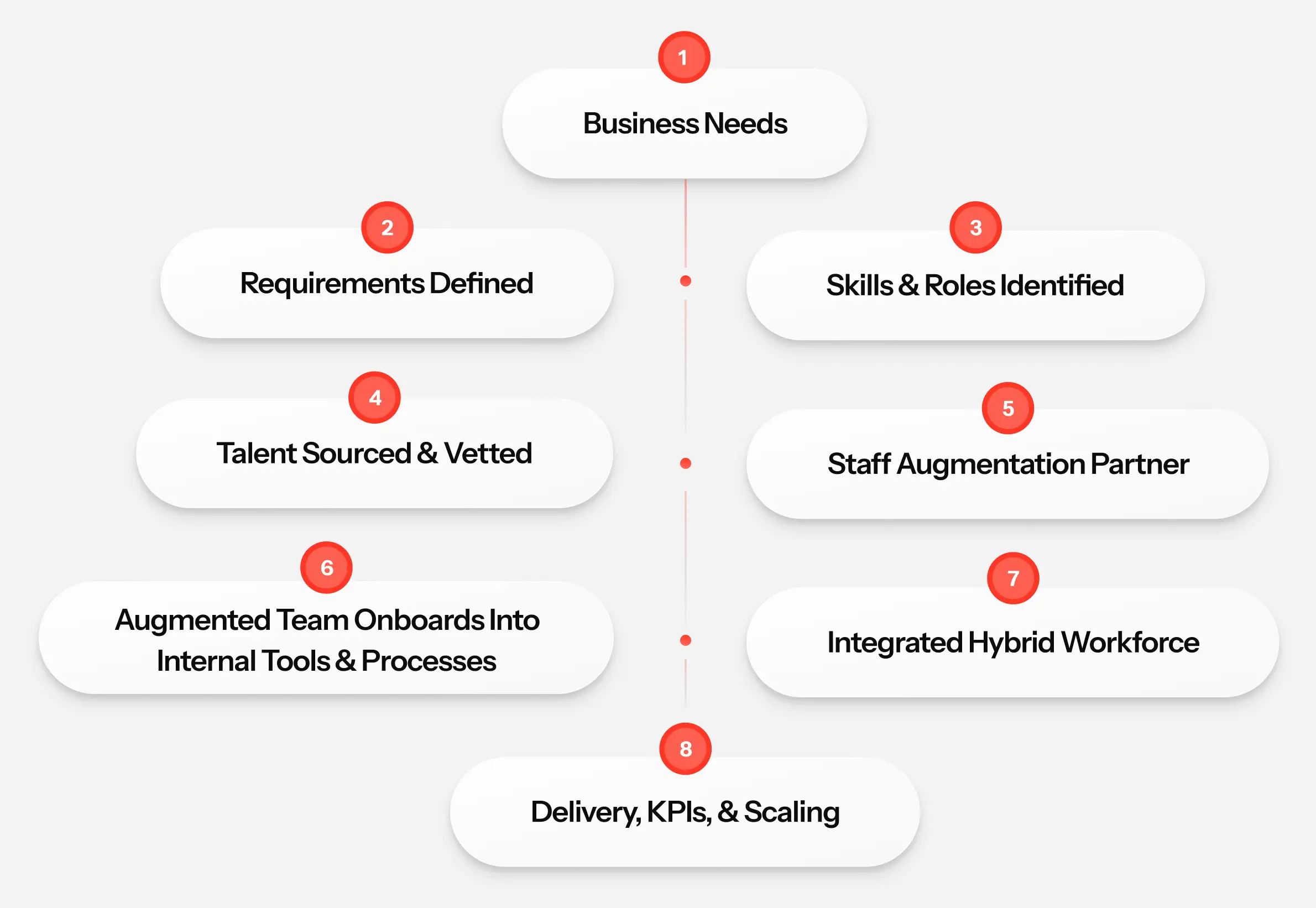
Here is the full, detailed staff augmentation model.
Staff Augmentation Process: Step-by-Step
IT staff augmentation is an easy 6-step process, as briefly discussed below.
Step 1: Assess Needs and Skill Gaps
Organizations begin by mapping capability gaps, project requirements, and timeline constraints. This includes reviewing:
- Current velocity
- Architecture complexity
- Existing team skill depth
- Compliance or security requirements
- Release schedules
Step 2: Define Scope, Roles, and Deliverables
Roles are defined based on:
- Backend, front-end, mobile, creative, or data requirements
- Expected output and milestones
- Needed seniority level
- Collaboration tools and processes
Step 3: Talent Sourcing and Vetting
The provider identifies specialists who align with your tech stack, culture, and delivery expectations. Vetting includes:
- Technical assessments
- Portfolio review
- Communication evaluation
- Experience match
Your provider should maintain transparent communication during this step.
Step 4: Onboarding and Integration
Augmented specialists join:
- Standups
- Sprint planning
- Architecture reviews
- Deployment pipelines
- Design system workflows
- Code review processes
They become part of the team from day one.
Step 5: Delivery and Continuous Improvement
After onboarding, the augmented workforce delivers on defined tasks. Teams measure:
- Sprint velocity
- Cycle time
- Quality indicators
- Defect rates
- Throughput
- Roadmap progress
Step 6. Scale Up or Down Based on Demand
Scaling is flexible. If new features arise, add more specialists. If projects slow down, reduce the augmented headcount.
This flexibility is why augmented hybrid workforces outperform rigid models.
Common Skill Sets Supported by Staff Augmentation
Staff augmentation supports nearly every technical and creative role, including:
| Mobile, Support, and Operations | AI Engineers | Creative Solutions for Hire |
|---|---|---|
| Mobile Developers | Front-end developer augmentation | UX researcher augmentation |
| iOS developer augmentation | Backend developer augmentation | Product designer augmentation |
| Android developer augmentation | AIOps engineer augmentation | UI designer augmentation |
| Flutter developer augmentation | DevOps augmentation | Content marketer augmentation |
| React Native specialist augmentation | Cloud architect augmentation | Motion designer augmentation |
| Support and Operations | Data engineer augmentation | |
| QA engineer augmentation | ML engineer augmentation | |
| Analyst augmentation | ||
| Project manager augmentation |
Staff Augmentation Best Practices: How to Ensure Success
Pendoah adheres to enterprise standard when sourcing the top talent for enterprises. Here are the best practices we follow stringently to ensure the best outcomes.
Define Outcomes, not Just Roles
Instead of saying “We need a backend developer”, define:
- The problem
- The outcome
- The dependencies
- The expected timelines
This clarity ensures better alignment.
Use Clear Governance and Communication
A hybrid workforce succeeds only when:
- Responsibilities are clear
- Daily standups are structured
- Documentation is consistent
- Code reviews follow a standard
- Access and permissions are secure
Integrate Augmented Talent into Your Culture
Treat augmented teammates as internal teammates. Include them in:
- Sprint ceremonies
- Celebrations
- Updates
- Roadmap briefings
They function better when they feel part of the mission.
Use Data to Track Performance
Data-driven metrics include:
- Cycle time: Measures how long a task takes from in progress to done, showing how efficiently work moves through the team.
- Lead time: Tracks the total time from request to delivery, revealing overall responsiveness.
- Velocity: Shows how much work the team completes per sprint, helping with planning and forecasting.
- Deployment frequency: Indicates how often code reaches production, reflecting delivery speed and pipeline maturity.
- Error rate: Measures how many defects or failures occur, helping improve quality and stability.
- Story completion time: Tracks how long individual stories take to finish, highlighting workflow bottlenecks.
These metrics help adjust workload and capacity.
Scale Based on Demand
A major advantage of staff augmentation is elasticity. When demand rises, scale up. When the project reaches a steady state, scale down. This preserves budget efficiency.
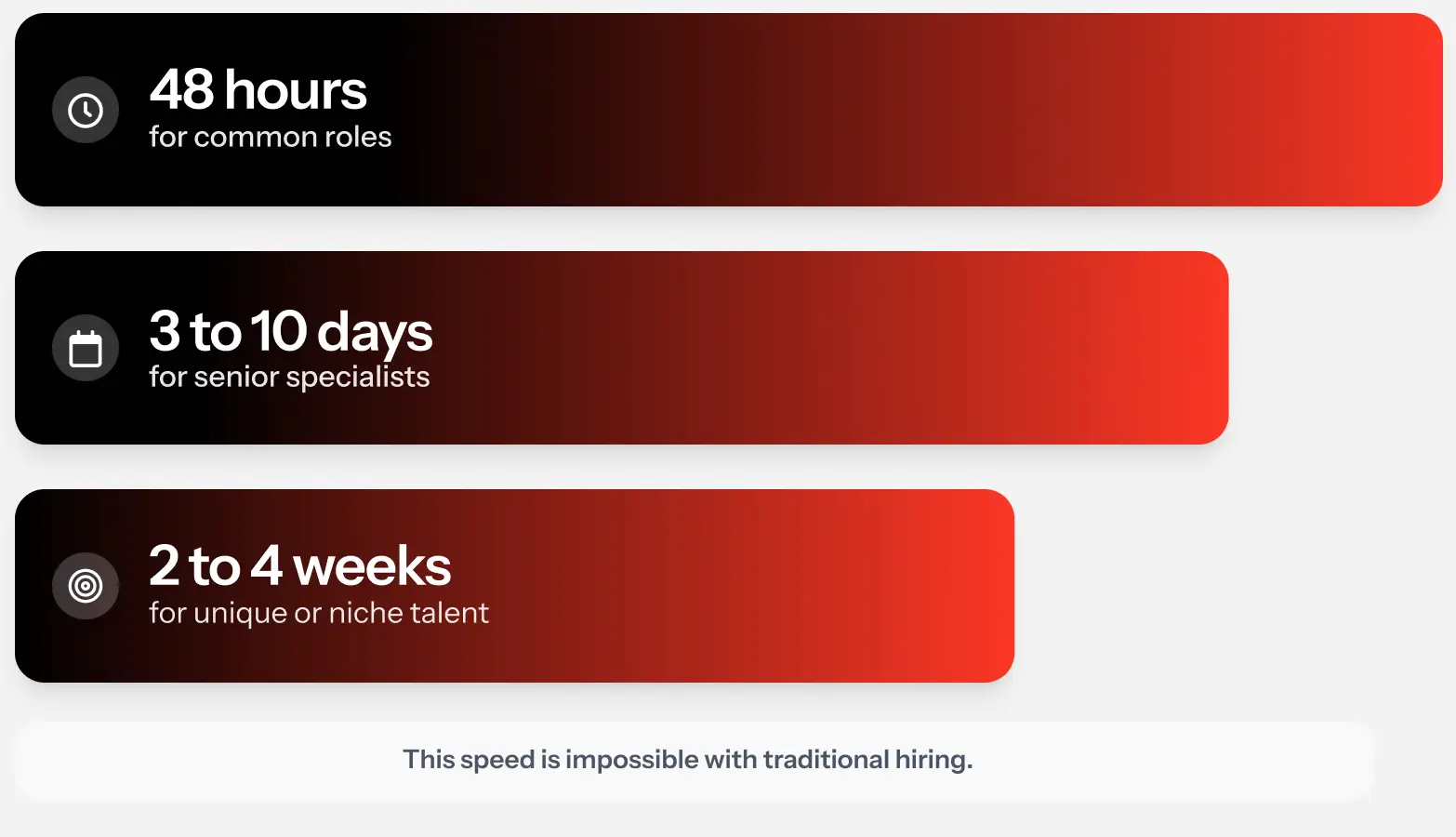
How Quickly Can Companies Scale with Staff Augmentation
Companies can scale within:
Example.
A SaaS company can add five React developers, two DevOps engineers, and a UX writer in under two weeks. This instantly unlocks delivery acceleration.
Final Takeaway
The workforce of 2026 will not rely solely on full-time employees, nor will it fully outsource operations. It will use a hybrid model where internal teams drive strategy, while augmented specialists provide agility, speed, and depth.
This combination helps organizations:
- Move faster
- Innovate more consistently
- Reduce operational risk
- Maintain control
- Scale confidently
- Deliver products with higher quality
- Compete at a global level
To explore how staff augmentation can support your engineering, creative, or operational roadmap, visit: