
Every data leader wants two outcomes at once.
One trusted view of the business. And the freedom for domains to move fast on their own platforms.
Your cloud data warehouse strategy is where these goals collide. Centralization promises clean metrics and simpler governance. Federation promises flexibility and local control. Hybrid models promise the best of both.
Here’s the problem:
Most organizations default to consolidation because it feels safe. Then they hit scaling issues – queues for pipeline slots, conflicting priorities, central teams becoming bottlenecks.
Others swing to federation too quickly. They end up with 12 different “sources of truth” and no way to answer basic questions like “What was Q3 revenue?”
This guide breaks down the consolidation vs federation decision into clear pieces so you can align architecture, governance, and cost with how your business actually runs.
Cloud Data Warehouse Strategy: The Core Decision
A cloud data warehouse strategy answers one question: Where does analytical truth live, and how do teams access it?
Here’s how the three approaches stack up:
| Approach | What It Means | Best For | Main Risk |
|---|---|---|---|
| Consolidate | One central warehouse (Snowflake, BigQuery, Redshift, Synapse). All data flows here. | Organizations needing single source of truth, strong governance, unified metrics | Central team becomes bottleneck — can’t move fast enough for all domains |
| Federate | Data stays distributed across sources. Virtual layer provides unified view. | Multi-region companies, strong domain teams, data residency requirements | Complexity at scale — governance fragmentation and performance inconsistency |
| Hybrid | Core domains consolidate; edge/operational data federates. | Most mid-market and enterprise organizations; ongoing migrations; M&A activity | Requires sophisticated data engineering to maintain both patterns |
The reality: 80% of successful cloud data warehouse strategies end up hybrid. The question isn’t “consolidate or federate it’s “what consolidates and what federates?”
Let’s break down each approach.
Consolidate: What a Central Warehouse Really Means
A consolidated cloud data warehouse strategy uses one primary analytical platform, Snowflake, BigQuery, Redshift, Synapse, or a lakehouse.
How It Works
Data from CRM, ERP, product, and marketing systems flows into the central platform on a regular cadence through ETL/ELT pipelines. The data team models shared dimensions: customer, product, region, time.
Finance, revenue operations, and leadership dashboards all pull from this curated core.
The Benefit: Clarity
People stop arguing about which number is correct. Governance and lineage live in one place through data governance frameworks. Cost conversations become simpler because most analytics spend concentrates on one warehouse.
Example: A SaaS company with $50M ARR consolidates all customer data (CRM, product usage, billing, support) into Snowflake. Finance runs revenue waterfalls. Product runs retention analysis. Sales runs pipeline forecasts. Everyone sees the same customer count.
The Trade-off: Dependency
Every new domain, metric, or pipeline competes for the same central team capacity. If that team is 3 people supporting 200 stakeholders, the warehouse becomes a choke point.
Real scenario: Marketing wants to analyze campaign attribution. Data team backlog is 6 weeks. Marketing builds their own shadow analytics in spreadsheets. Now you have two conflicting attribution numbers.
When Consolidation Works Best
Choose consolidation when:
- Business needs one authoritative set of numbers for revenue, margin, and risk
- Regulatory scrutiny requires strong lineage and repeatable reporting (healthcare, financial services)
- Data culture is emerging, and central leadership is necessary
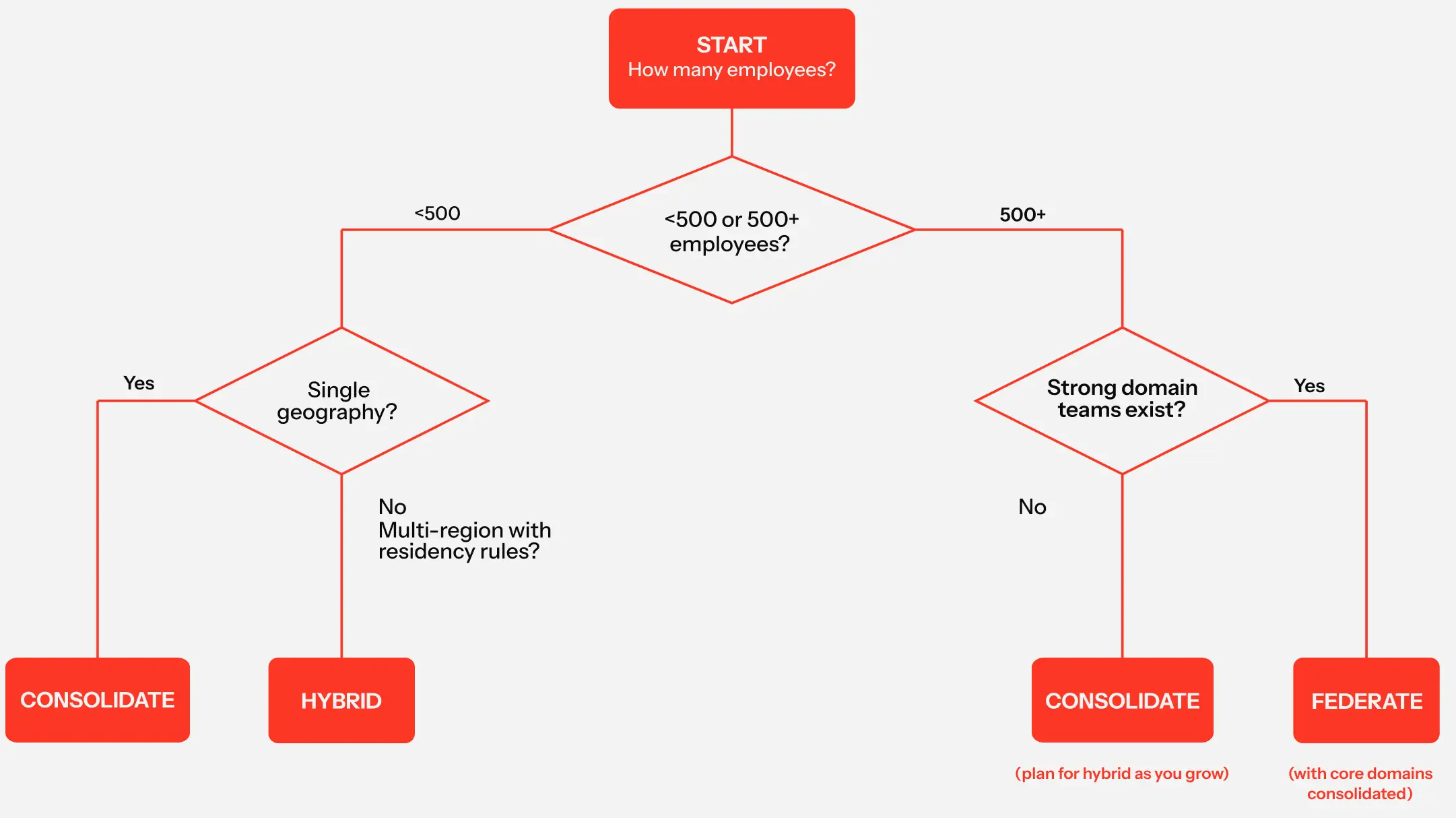
- Your organization is <500 employees with manageable data domains
Federate: What a Distributed Model Actually Looks Like
A federated cloud data warehouse strategy keeps data closer to its sources.
How It Works
Sales data stays in one cloud region. Manufacturing data stays on-premises. Customer interaction data lives on a separate platform owned by digital or product.
A virtualization or query layer (Starburst, Denodo, Dremio, or Databricks Unity Catalog) sits on top and presents a unified view. Domains own their schemas and quality standards. Central teams provide shared platforms, security rules, and conventions.
Queries reach across multiple systems without copying every table into a warehouse first.
The Benefit: Flexibility
Domains move at their own speed. Real-time operational data stays where it performs best. Regional teams respect data residency laws. Acquired business units keep their existing platforms during integration.
Example: A manufacturing company operates plants across 6 countries. Each region runs its own ERP. Local regulations prohibit moving production data to US clouds. Federation layer lets global leadership query “total production by SKU” without centralizing sensitive data.
The Trade-off: Complexity
Performance varies with network health and source system availability. Governance must work across many technology stacks, not just one warehouse. Query optimization becomes harder when data is scattered.
Real scenario: Finance runs a quarterly close report. The query touches 8 different source systems. One system is offline for maintenance. Report fails. Finance can’t close books on time.
When Federation Works Best
Choose federation when:
- Several business units already run their own engineering and data teams
- Large portions of data cannot move due to residency, latency, or contracts
- Operational dashboards need live data across many systems
- You’re a distributed organization (500+ employees, multiple regions/business units)
Hybrid: How Most Mature Strategies Actually Work
A hybrid cloud data warehouse strategy combines both patterns strategically.
How It Works
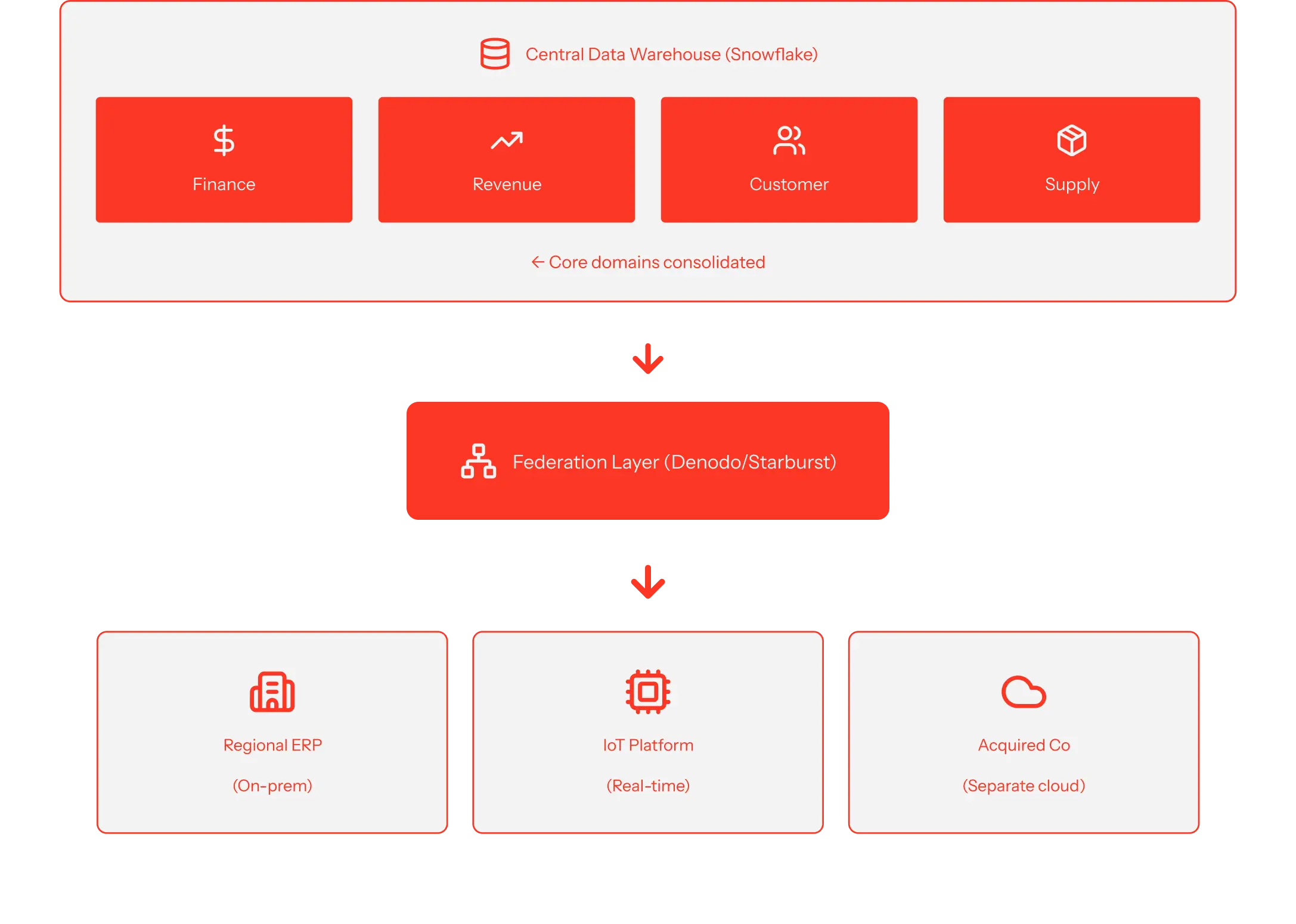
Core domains consolidate into a central warehouse:
- Finance data (GL, AR, AP)
- Revenue data (billing, subscriptions, bookings)
- Customer lifecycle (CRM, marketing, support)
- Supply chain (inventory, procurement, fulfillment)
These domains get cleaned, modeled data with a long history. Single source of truth for enterprise metrics.
Other domains stay federated:
- Real-time operational systems
- Edge workloads (IoT, mobile apps)
- Acquired business units (during integration period)
- Highly regulated regional stores
- AI/ML feature stores
These domains expose data through virtual layers, API integrations, or data mesh endpoints.
The Architecture
The Benefit: Pragmatic Balance
You get a single source of truth where it matters most (core business metrics) while maintaining flexibility in domains that need speed or have constraints.
Example: A retail company consolidates POS, inventory, and finance data into BigQuery (ecommerce backbone). Real-time personalization engine stays federated in its own low-latency platform. Federation layer lets marketing query “customers who bought X but didn’t engage with email.”
The Trade-off: Architectural Overhead
You need expertise in both warehouse optimization AND federation layer management. More moving parts mean more operational complexity. But for mid-market and enterprise organizations, this overhead is worth it.
When Hybrid Makes Sense
Choose hybrid when:
- You already have a cloud warehouse and want to add data mesh capabilities
- You’re in a multi-year migration from on-premises to cloud
- You expect ongoing M&A activity bringing new stacks
- Different domains have fundamentally different needs (compliance vs speed, historical vs real-time)
Pros and Cons: Decision Matrix
Here’s the complete comparison for stakeholder discussions:
| Approach | Pros | Cons |
|---|---|---|
| Consolidation | – Single source of truth (no metric conflicts) – Simpler governance and lineage – Centralized cost management – Easier to optimize query performance – Stronger data quality controls |
– Central team becomes bottleneck – Slower to support new use cases – Can’t handle real-time operational needs well – Data residency challenges for global companies – High coupling between domains |
| Federation | – Domains move at their own speed – Respects data residency and sovereignty – No need to copy/move all data – Preserves existing platform investments – Scales team autonomy naturally |
– Complex governance across stacks – Inconsistent performance (depends on sources) – Harder to enforce data quality standards – Query optimization challenges – Requires sophisticated virtualization platform |
| Hybrid | – Balance between control and flexibility – Right tool for each use case – Gradual migration path (not big-bang) – Accommodates M&A and growth – Supports both historical analysis and real-time ops |
– Higher architectural complexity – Need expertise in multiple technologies – More operational overhead – Requires clear domain boundaries – Can create confusion if not well-governed |
Which Cloud Data Warehouse Strategy Should You Choose?
There’s no universal winner. The right approach depends on your size, structure, and regulatory environment.
Start With These Questions
Question 1: Do you need one authoritative answer for “How much revenue did we generate?”
If yes → Consolidation should be your foundation (at least for finance/revenue domains).
Question 2: Do you have strong domain teams that own their own platforms?
If yes → Federation deserves priority (with shared governance standards).
Question 3: Are you in a regulated industry with strict data residency requirements?
If yes → Federation may be required for certain regions (government, healthcare, banking with EU/Asia operations).
Question 4: Are you growing through M&A or expect to acquire companies?
If yes → Hybrid gives you the flexibility to integrate gradually.
Question 5: Is your central data team <5 people supporting 100+ stakeholders?
If yes → You need either federation (distribute ownership) or staff augmentation to scale your central team.
Decision Tree
The 12-Month Test
For Consolidation: If central team can deliver new use cases in < 4 weeks and stakeholders trust the metrics → You’re good.
For Federation: If domains can query cross-platform data in < 2 seconds with consistent governance → You’re good.
For Hybrid: If core metrics come from warehouse but domains can self-serve operational analytics → You’re good.
If none of these are true: Your cloud data warehouse strategy needs adjustment.
Implementation: From Strategy to Production
A cloud data warehouse strategy isn’t just an architecture decision. It’s a talent and execution question.
What Implementation Actually Involves
For Consolidation:
- Design data pipelines (ETL/ELT) for ingestion
- Model dimensional data (customers, products, time, geography)
- Build transformation layers (staging → curated → consumption)
- Implement data quality checks and monitoring
- Set up cost controls and query optimization
Timeline: 12-16 weeks for initial warehouse, 4-6 weeks per new domain.
For Federation:
- Deploy virtualization platform (Starburst, Denodo, Databricks Unity)
- Catalog all source systems and APIs
- Define governance standards across sources
- Implement security and access controls
- Build query optimization and caching layers
Timeline: 16-20 weeks for federation layer, 2-3 weeks per new source integration.
For Hybrid:
- All the above, plus clear domain classification
- Define what consolidates vs what federates (and why)
- Build integration points between warehouse and federation layer
- Implement unified governance across both patterns
Timeline: 20-24 weeks for full hybrid infrastructure, ongoing optimization.
How Pendoah Accelerates Your Cloud Data Warehouse Strategy
Pendoah helps mid-market and enterprise leaders move from theory to production in two ways:
1. Data Strategy & Platform Design
We work with your CDO, CTO, and data leadership to design a cloud data warehouse strategy that fits your governance, AI ambitions, and budget.
What we deliver:
- Current State Assessment: Map existing warehouses, lakes, operational systems, and data flows
- Domain Classification: Categorize domains into consolidate, federate, and hybrid buckets with clear rationale
- Target Architecture: Design patterns for ingestion, modeling, and federation on your chosen platforms (AWS, Azure, GCP)
- ROI Quantification: Model impact on cost, time-to-insight, and AI readiness
- Roadmap: 12-24 month phased plan with milestones, dependencies, and resource needs
Timeline: 4-6 weeks
Result: You get a pragmatic consolidation vs federation blueprint, not a generic reference architecture.
2. AI-Native Staff Augmentation for Data Teams
Most teams already know the direction. The constraint is a specialized capacity.
Pendoah’s staff augmentation supplies data engineers, analytics engineers, and platform specialists who:
- Build and optimize pipelines into your cloud data warehouse
- Stand up secure, observable federation or mesh layers
- Implement MLOps for AI workloads on your warehouse
- Use AI tools safely to accelerate development while preserving compliance
- Transfer knowledge to your team (not just “do the work and leave”)
Engagement models:
- Fixed-term projects (12-16 weeks)
- Ongoing augmentation (quarterly or annual)
- Hybrid: Strategy phase → Implementation phase → Handoff
This combination lets you execute your cloud data warehouse strategy without waiting through long hiring cycles or risking ad-hoc decisions.
Ready to Design Your Cloud Data Warehouse Strategy?
The right cloud data warehouse strategy balances architectural purity with business pragmatism.
- Consolidation gives you control and consistency but can slow you down.
- Federation gives you speed and flexibility but can fragment governance.
- Hybrid gives you the best of both at the cost of complexity.
Most successful mid-market and enterprise organizations end up hybrids. The question is which domains consolidate (your “core”), and which federate (your “edge”).
Start With a Strategy Session
Book Your Free Cloud Data Strategy Call →
In 45 minutes, we’ll:
- Review your current data architecture
- Identify consolidation vs federation opportunities
- Outline a pragmatic 12-24 month roadmap
- Discuss talent gaps and how to fill them
Or Get a Data Readiness Assessment
We’ll evaluate:
- Your data maturity across domains
- Infrastructure gaps blocking AI/analytics initiatives
- Cost optimization opportunities
- Governance and compliance readiness
The Future of Cloud Data Warehouses
The industry is moving from “warehouse vs lake vs mesh” debates toward pragmatic coexistence.
Forward-thinking cloud data warehouse strategies recognize:
- Different data deserves different treatment: Core metrics need consolidation; operational data needs federation
- Governance must work everywhere: Whether data lives in a warehouse or stays federated, governance cannot be optional
- AI changes everything: AI and ML workloads demand both historical depth (consolidated) and real-time features (federated)
- Cost optimization never stops: Hybrid strategies let you right-size spend across platforms
The best cloud data warehouse strategy isn’t the one that follows trends. It’s the one that fits how your business runs, scales with how you’ll grow, and gives teams the data they need when they need it.
Build deliberately. Govern responsibly. Scale confidently.