
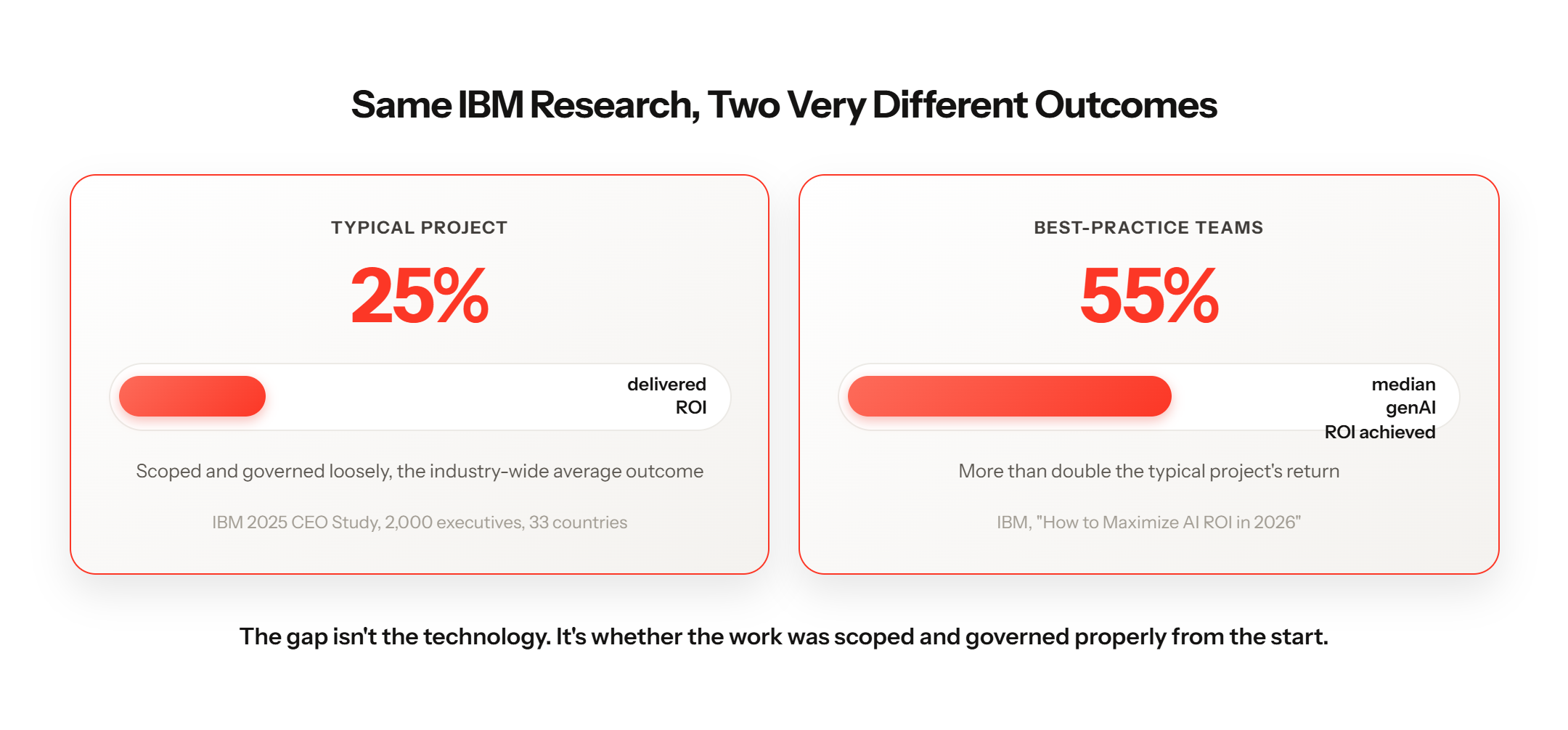
Only 25% of AI initiatives have delivered their expected ROI over the past three years, and just 16% have scaled past a pilot, according to IBM’s 2025 CEO study of 2,000 executives (IBM, Agentic AI is here). Gartner separately predicts that more than 40% of agentic AI projects will be cancelled by the end of 2027, mostly from escalating costs and unclear business value (Gartner, 2025 press release).
The other side of that same research is worth just as much attention: IBM’s own analysis found that product teams who followed AI best practices closely reported a median ROI of 55% on their generative AI work, more than double what the typical project sees (IBM, How to Maximize AI ROI in 2026). The gap between 25% and 55% isn’t a technology gap. It’s the difference between teams that scoped the work and governed it properly, and teams that didn’t.
Neither the discouraging numbers nor the encouraging one are really about the technology itself. All three are describing what happens when a company picks an AI agent development partner based on a confident pitch instead of a clear-eyed evaluation of scope, delivery process, and what happens after launch. This guide is that evaluation, the questions and criteria that actually separate a partner who ships a working agent from one who ships a demo.
What AI Agent Development Services Actually Include
The term covers more ground than most pitches let on, and knowing the full scope matters because a partner who’s strong at one part of it can still leave you exposed at another. A complete engagement typically includes:
- Discovery and use-case scoping: mapping which processes are actually good candidates for an agent, not just which ones sound impressive in a pitch deck. This is the part Pendoah’s AI Strategy Consulting work is specifically built around, and it’s also the part most buyers skip past to get to the exciting build conversation.
- Custom agent builds: the actual planning logic, tool access, and reasoning that let the agent complete a multistep task rather than just respond to a prompt.
- Systems integration: connecting the agent to your CRM, ERP, databases, or internal tools through APIs, without disrupting what already works.
- Governance and access control: defining exactly what the agent can touch, what requires human approval, and how every action gets logged.
- Production monitoring and maintenance: because an agent that worked in a demo needs ongoing attention as your systems, data, and edge cases change.
Here’s the part worth sitting with: a vendor who only offers the middle item on that list, the build itself, isn’t really offering AI agent development services. They’re offering a prototype, and quietly leaving the hardest 80% of the work, the part that actually determines whether the thing survives contact with real production data, for you to figure out after the invoice is paid.
How to Evaluate an AI Agent Development Company
Most buyer’s guides in this space tell you to check “experience” and “client reviews.” That’s not wrong, but it’s not specific enough to actually distinguish anyone. The questions that reveal real capability are more concrete:
Can they describe failure, not just success?
Every agentic AI project hits an edge case the model handles badly. A partner who can walk you through a real example of that happening, and what they changed in response, has actually operated an agent in production. One who only has polished success stories probably hasn’t.
Do they talk about governance before you ask?
If access controls, audit logging, and human-in-the-loop thresholds only come up when you bring them up, that’s a signal governance is an afterthought in their process, not a starting point. It should be built in from the first architecture conversation, not bolted on after a security review flags a gap.
Can they explain their integration approach without ecosystem lock-in?
Watch for whether the proposed architecture ties your agent’s core logic to one vendor’s platform in a way that makes switching providers later expensive or impossible. A partner confident in their work generally isn’t afraid of you being able to leave.
Vendor Evaluation Checklist
| Criteria | What to ask | Red flag |
| Discovery process | “How do you decide which of our processes are actually good agent candidates?” | Jumps straight to a build proposal without process mapping |
| Governance approach | “What access controls and audit logging come standard?” | Treats governance as a later add-on or upsell |
| Integration method | “How does the agent connect to our existing systems?” | Vague answer, or requires replacing systems that already work |
| Failure handling | “What happens when the agent reaches a wrong conclusion?” | No clear answer, or claims it “won’t happen” |
| Production support | “What does support look like after launch?” | Support ends at go-live with no monitoring plan |
| Data ownership | “Who owns the model, the data, and the resulting IP?” | Ambiguous or vendor-retained ownership by default |
Questions to Ask About Production Readiness
A pilot that works is not the same thing as a system ready for production, and the gap between the two is exactly where IBM’s 16%-scaled figure comes from. Before signing off on any agent going live, get clear answers to:
- What percentage of real, historical cases did this get right during testing, not just the curated demo cases?
- What happens when the agent is uncertain? Is there a defined threshold for escalating to a human, or does it guess?
- Who is accountable once this is live, and how is that documented?
- Is every action the agent takes logged in a way that would satisfy an audit?
We go deeper on this specific gap, and how to design for it rather than discover it after launch, in our AI Compliance guide and Layered Governance Architecture.
What a Realistic Engagement Timeline Looks Like
Timelines vary enough by scope and integration complexity that a single number isn’t honest.
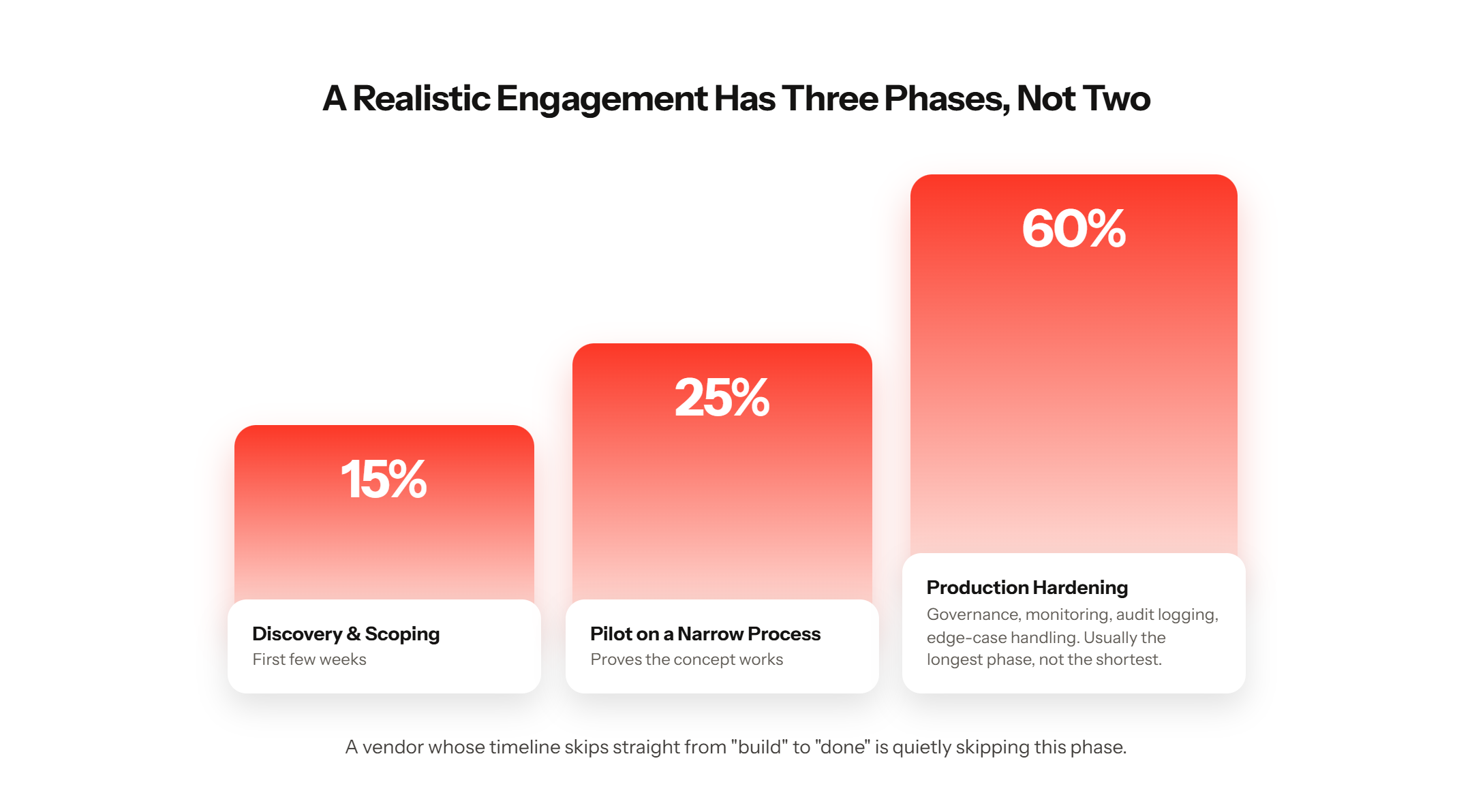
What’s more useful than a promised date is understanding the phases: discovery and scoping typically takes the first few weeks, a working pilot on a narrow, well-defined process comes next, and production hardening, the governance, monitoring, and edge-case handling, is usually the longest phase, not the shortest.
A vendor whose timeline skips straight from “build” to “done” is quietly skipping that last phase, and it’s the one that determines whether you end up in IBM’s 25% or the other 75%.
Red Flags That Predict a Cancelled Project
Gartner’s cancellation forecast isn’t random, and the projects that get canceled tend to fail for reasons that were visible before the contract was ever signed, if anyone had been looking for them:
- The business case was built on the agent’s capability, not on a specific process’s cost, volume, and error rate.
- Governance was treated as a compliance checkbox rather than a design requirement from day one.
- The vendor’s timeline had no visible production-hardening phase.
- Success was defined as “the agent works” rather than a measurable business outcome.
- Nobody could answer what happens when the agent is wrong, only what happens when it’s right.
None of these are technology failures. They’re scoping failures, which is exactly why they’re avoidable before a dollar gets spent, not just diagnosable after the project gets quietly shelved.
Where Pendoah Fits
Pendoah’s own case studies are a useful reference point for what a completed engagement actually looks like, not just a build.
ProVal AI, a validation platform for MedTech and pharma clients, achieved 65% faster validation cycles and 40% fewer review iterations, numbers that came from the governance and review-logic work as much as the underlying model.
Worklighter’s document-automation engine auto-processes 90% of incoming invoices and routes the rest to a person, a real example of the escalation designs this guide keeps coming back to.
GALSI went from concept to a production-ready, multi-tenant platform in 8 weeks, a timeline that’s realistic specifically because it included the integration and governance work from the start rather than treating it as phase two.
If you’re currently scoping this kind of work, Pendoah’s Agentic AI Development service is built around the same discovery-first, governance-included approach this guide describes, rather than a build-only engagement that leaves the hardest 80% to you.
Key Questions to Ask Before You Sign
- Does the proposal include discovery and use-case scoping, or does it start with the build?
- Is governance, access control, and audit logging part of the base engagement, or a separate line item?
- Can the vendor describe a real failure they’ve handled, not just a success story?
- What does the vendor’s post-launch support and monitoring plan actually look like?
- Who owns the model, the data, and the resulting IP once the engagement ends?
The Bottom Line
The technology behind AI agent development services isn’t what’s driving IBM’s 25% ROI figure or Gartner’s cancellation forecast.
The partner selection and delivery scope are:
A vendor who leads with discovery, builds governance from the start, and can describe a real failure they’ve handled is a fundamentally different bet than one who leads with a demo and a signature line.
Ready to scope an AI agent development engagement the right way?
Book a consultation with Pendoah, or look through our case studies to see how this played out for other clients.