If you’re trying to figure out whether a process needs RPA or AI, the vendors pitching you aren’t going to make that easy. Both terms get stretched to cover almost any automation project, which makes it easy to buy the wrong one: AI capability you don’t need yet, or an RPA bot that can’t make the judgment call you’re expecting it to make.
The real distinction is straightforward once it’s separated out properly. That’s what this post does, along with a decision framework you can use the next time this choice comes up.
How Robotic Process Automation Actually Works
Robotic process automation is software that operates the way a human user would inside an existing application: logging in, clicking, typing, copying a value from one field into another, checking a rule, and moving on. It follows a fixed script. Give it the same input twice, and it does the exact same thing twice.
That’s a feature, not a limitation. Every action an RPA bot takes is deterministic and fully logged, which is exactly what makes it straightforward to govern: there’s no ambiguity about what happened or why.
How Artificial Intelligence Actually Works
Artificial intelligence is a different category of technology entirely. The U.S. National Institute of Standards and Technology defines AI as a machine-based system that, given a set of human-definedobjectives, can make predictions, recommendations, or decisions based on real or virtual inputs, rather than following a fixed script step by step (NIST, artificial intelligence glossary entry).
In practice, that means AI is built to handle exactly what RPA can’t: unstructured information and judgment calls. Reading a handwritten note, classifying an ambiguous support ticket, predicting which invoice is likely fraudulent. None of that has a fixed rule that covers every case. AI is trained to make a probabilistic best guess instead of following an if/then script, which is also why AI systems need a different kind of oversight than rule-based bots do.
RPA vs. AI: The Core Difference Is Rules vs. Judgment
Laid out side by side, the differences look like this:
| Use Criteria | Robotic Process Automation | Artificial Intelligence |
| How it decides | Follows fixed, pre-programmed rules | Makes a probabilistic judgment based on patterns in data |
| Best suited for | Structured, repetitive, rules-based tasks | Unstructured information and ambiguous decisions |
| Consistency | Identical output every time, given identical input | Output can vary as the underlying model or data changes |
| Auditability | Every step is deterministic and fully logged | Reasoning is probabilistic; explainability takes more deliberate design |
| Learns over time | No. Behavior only changes when someone edits the rules | Yes, when retrained on new data |
| Fails when | The input format changes or an edge case falls outside the rules | The training data doesn’t represent the real-world case in front of it |
The risk profiles actually play out pretty differently, too. If an RPA bot’s login credentials expire or a form field moves on a system update, the bot stops cold and someone notices within the hour, because nothing gets processed.
An AI model doesn’t fail that way. If the data it’s seeing starts to drift from what it was trained on, say a lender’s applicant pool shifts and starts looking different from the historical data the model learned on, the model doesn’t stop. It keeps producing scores. They’re justgradually less accurate, and unless someone is actively monitoring accuracy, that kind of failure can run for weeks before a pattern of bad decisions gets noticed.
Invoice Processing: The Same Task, Two Different Tools
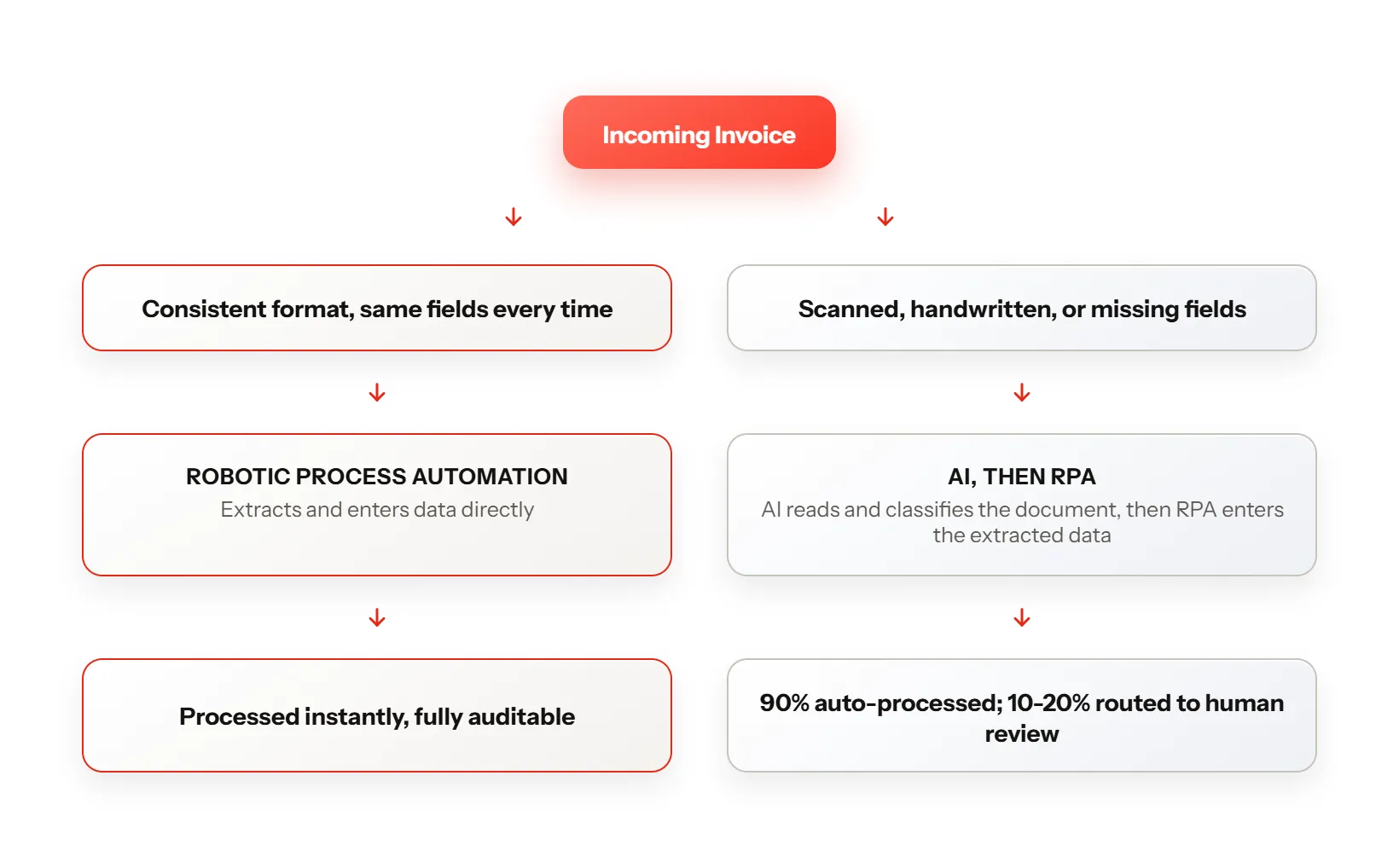
Consider invoice processing, a task almost every finance team deals with at volume. If every invoice arrives in the same format, with the same fields in the same place, RPA can extract the data and enter it into your accounting system without ever needing to interpret anything. It’s rule-based work, and RPA is the cheaper, faster, more auditable choice for it.
But if invoices arrive from dozens of vendors in dozens of formats, some scanned, some handwritten, some missing fields, that’s no longer a task with a fixed rule. That’s exactly where AI earns its place: reading unstructured documents and extracting the right data regardless of layout.
Invoices don’t always fall cleanly into “structured” or “unstructured.” An invoice number usually sits near the top. A total usually sits near the bottom. But the exact layout, wording, and field order still shift from vendor to vendor. That’s semi-structured data: more predictable than a scanned handwritten note, but less predictable than a fixed template.
RPA can sometimes still handle semi-structured data, but only when the variation is limited and known in advance. If a process only ever receives invoices in three or four recognizable template formats, a bot can be built with conditional logic to handle each one, effectively treating “semi-structured” as a small, finite set of structured formats. The moment the number of formats grows, or new ones appear without warning, that approach breaks down fast, and that’s the point where AI’s ability to generalize across unseen layouts becomes the more reliable choice.
This isn’t hypothetical.
Pendoah built Worklighter’s document-automation engine to handle exactly this mix: it now auto-processes 90% of incoming invoices, with only 10 to 20% requiring human review. The 90% that go through cleanly are the structured, predictable cases; the 10 to 20% that get routed to a human are the ones where the format, quality, or content falls outside what a fixed rule can reliably handle.
That routing decision is itself the practical answer to “RPA or AI,” and it’s the same human in the loop principle at work: automate what’s safe to automate, and route the rest to a person instead of guessing.
When to Choose RPA Over AI
- The task is repetitive, high-volume, and follows the same steps every time
- The data is structured and in a consistent, predictable format
- You need every action logged, auditable, and identical on every run
- There’s no API available, and the bot needs to work through an existing user interface (a common situation with legacy systems, mainframes, and older internal tools)
- The ROI depends on speed and consistency, not judgment
When to Choose AI Over RPA
- The input is unstructured: free text, scanned documents, images, or handwritten notes
- The task requires classifying, predicting, or making a judgment call rather than following a rule
- Edge cases are common enough that a fixed rule set would break constantly
- You’re willing to invest in monitoring model accuracy over time, since AI output can drift as data changes
- The value comes from handling variation, not from doing the identical thing every time
A useful proof point here: when Pendoah built StatSafe for a life sciences client, the task was translating plain-English questions into accurate database queries. There’s no fixed rule that covers every way a person might phrase a question, which is exactly why that project needed AI rather than a rules engine, and why accuracy (92% query accuracy) was the metric that mattered, not just speed.
When RPA and AI Work Better Together
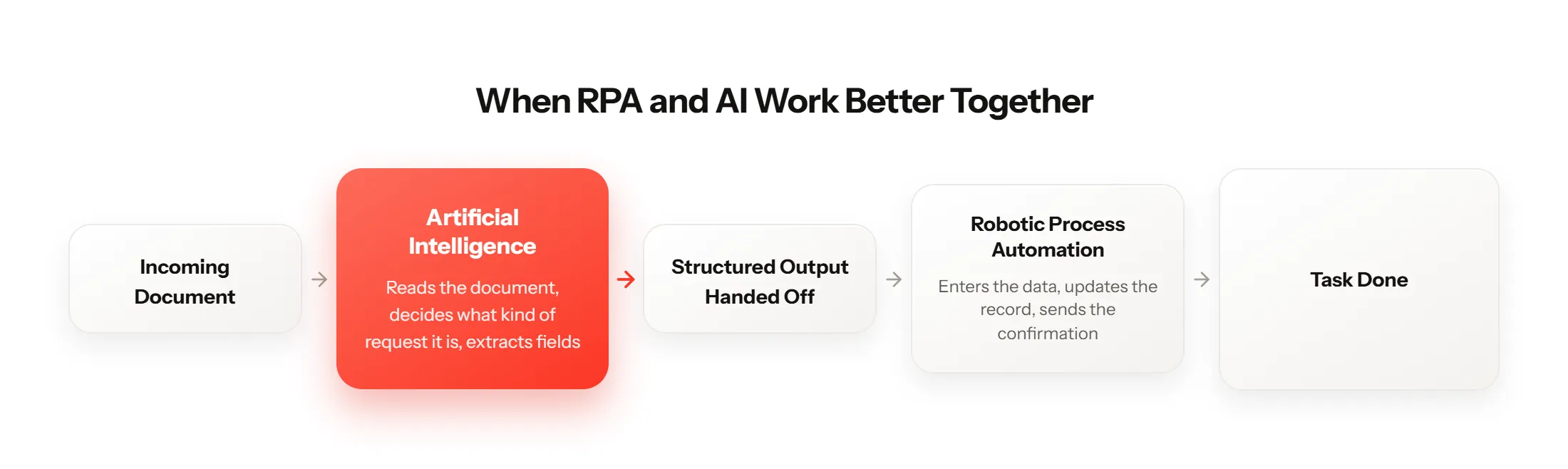
In practice, the two increasingly get deployed together rather than picked as one or the other. A common pattern: an incoming document lands in the system, and an AI model reads it, figures out whatkind of request it is, and pulls out the relevant fields. It hands that structured output to an RPA bot, which takes it from there, enters it into the system of record, updates the status, and sends the confirmation. The AI made the one judgment call the process actually needed. Everything after that point is repeatable and rule-based, so RPA handles it.
That combination, plus the further question of when it’s worth adding a fully autonomous AI agent instead of this kind of handoff, is its own conversation. We get into it in Agents at Scale.
Don’t let that combination talk you into overcomplicating a simple project, though. Most tasks are still cleanly one or the other, and assuming every automation needs both AI and RPA is a common way teams end up building more than the problem actually required.
RPA vs. AI: A 5-Step Decision Framework
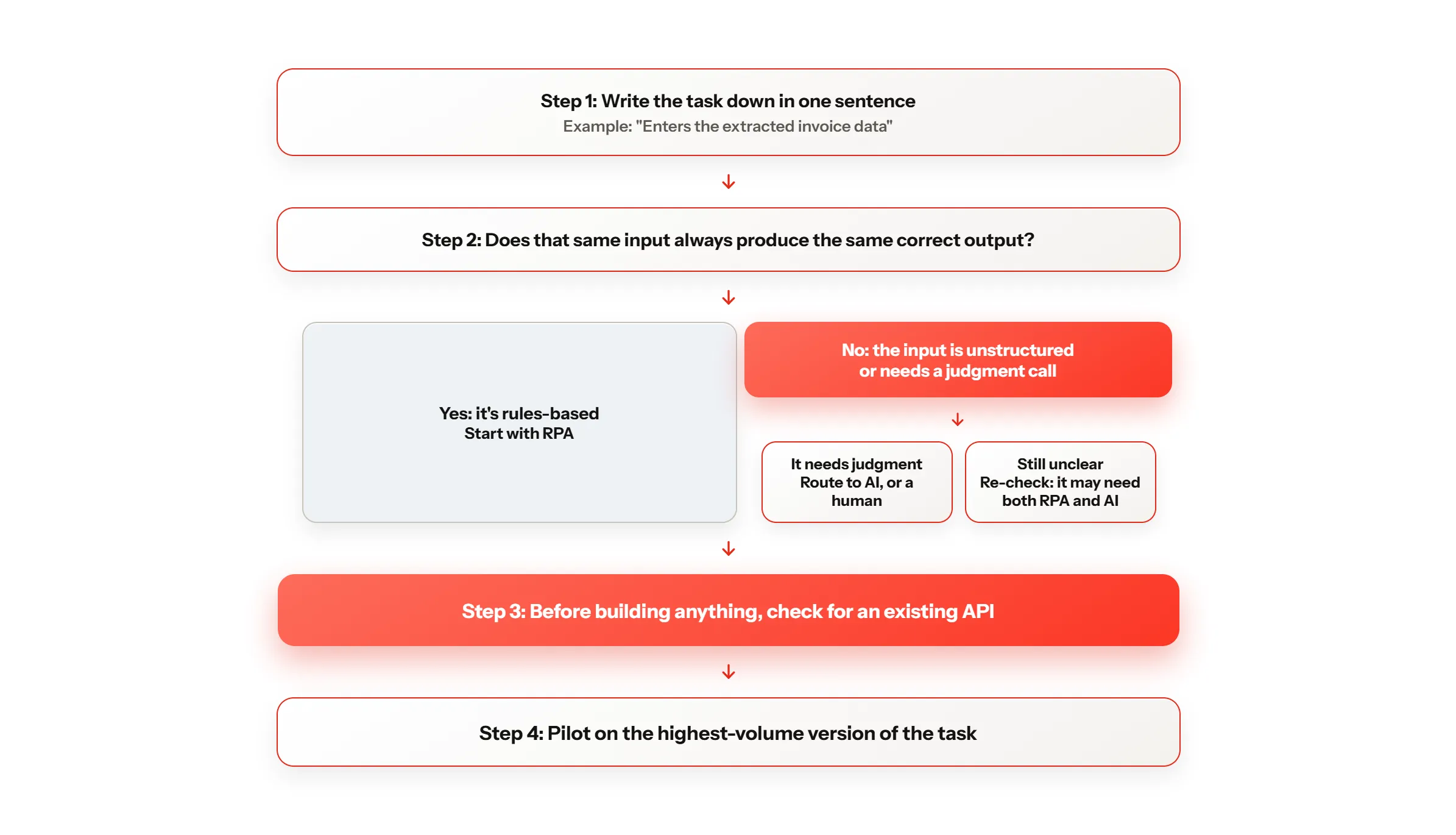
- Write down the task in one sentence, including exactly what triggers it and exactly what the output should be.
- Ask whether the same input always produces the same correct output. If yes, that’s a rules-based task. Start with RPA.
- Ask whether the input is unstructured (free text, images, inconsistent formats) or requires a judgment call. If yes, you need AI, or a human, not a fixed rule.
- Check whether an API already exists for the systems involved. If it does, a direct integration is usually more reliable than either RPA or AI. RPA is a workaround for systems that don’t expose one.
- Pilot on the highest-volume version of the task first. Both RPA and AI return their best ROI on high-volume, well-defined work, not one-off edge cases.
If you get through this and the task still feels like it needs both, that’s normal. That’s the territory covered above, and it’s worth a proper conversation rather than a guess.
Key Questions to Ask Before Choosing RPA or AI
- Does this task have a fixed set of rules that covers every real-world case we’ve seen, or are there frequent exceptions?
- Is the input structured and consistent, or does it vary in format from one instance to the next?
- Do we need every decision to be identical and fully auditable, or is some variation acceptable?
- Is there already an API for this system that we’re overlooking in favor of a bot?
- If we start with RPA, do we have a plan for the exceptions it can’t handle, or will they pile up unresolved?
The Bottom Line on RPA vs. AI
RPA and AI aren’t competing for answers to the same question. RPA is the right tool when a task is repetitive and rules-based. AI is the right tool when a task requires interpreting unstructured information or making a judgment call.
Most real automation problems have a clear answer once you separate the rules-based parts from the judgment-based parts, rather than picking a technology first and looking for a use case to justify it.
Not sure which side of that line your process falls on? Book a consultation with Pendoah, or browse our case studies to see how this decision played out for other clients, and we’ll help you map the process before recommending a tool.