
Every AI vendor pitch this year seems to use “agentic” somewhere in the first slide, often to describe something that’s really just a chatbot with a new label. That matters, because generative AI and agentic AI aren’t two flavors of the same thing. They solve different problems, they carry different risks, and mixing them up in a planning conversation leads to buying the wrong tool, or worse, deploying the right tool without the oversight it actually needs.
Here’s the distinction in plain terms, and what it actually changes about how you should evaluate, deploy, and govern each one.
What Generative AI Actually Does
Generative AI produces new content in response to a prompt: text, images, code, summaries. You ask, it answers. It doesn’t act on that answer unless a person or a separate system decides to. Ask it to draft an email, and you get a draft. It doesn’t send anything, follow up, or remember the conversation existed once the session ends, unless you’ve built something around it that does.
That request-response pattern is the whole model. Each interaction stands on its own. The tool has no ongoing objective it’s working toward between prompts, which is exactly why it’s a poor fit for anything that requires follow-through over time.
What Agentic AI Actually Does
Agentic AI is built around the opposite pattern: a goal, not a prompt. IBM defines it as an AI system that can accomplish a specific goal with limited supervision, made up of AI agents that mimic human decision-making to solve problems in real time (IBM, What is Agentic AI?). Give it an objective, and it plans the steps, calls the tools or systems it needs, checks its own progress, and adjusts if something along the way doesn’t go as expected.
The practical difference shows up in what happens after the first response. A generative tool gives you a draft and stops. An agentic system might draft the email, decide it needs a piece of information it doesn’t have, query a database to get it, revise the draft, and then send it, all without a person prompting each individual step.
Agentic AI vs. Generative AI: The Core Difference
Nearly every credible source on this comparison lands on the same framing: generative AI is reactive, agentic AI is proactive. That’s accurate, but it’s easy to nod along with it without registering what it actually implies operationally. Laid out side by side:
| Generative AI | Agentic AI | |
|---|---|---|
| Triggered by | A prompt, each time | A goal, set once |
| Output | Content: text, images, code | Completed outcomes: actions taken, systems updated |
| Runs how many steps | One response per prompt | Multiple steps, chained toward the goal |
| Memory across steps | Typically, none by default | Maintains state across the task |
| Human involvement | Required for every new request | Required to set the goal and guardrails, not every step |
| What it needs to work | A model and a prompt | A model, plus tools, system access, and a defined scope of action |
The important row is the last one. Agentic AI needs access to actually do things: it calls APIs, updates records, triggers workflows. That access is exactly what makes it useful, and exactly what makes it a different category of risk than a tool that only ever produces text on a screen.
A Concrete Example: The Same Task, Two Different Tools
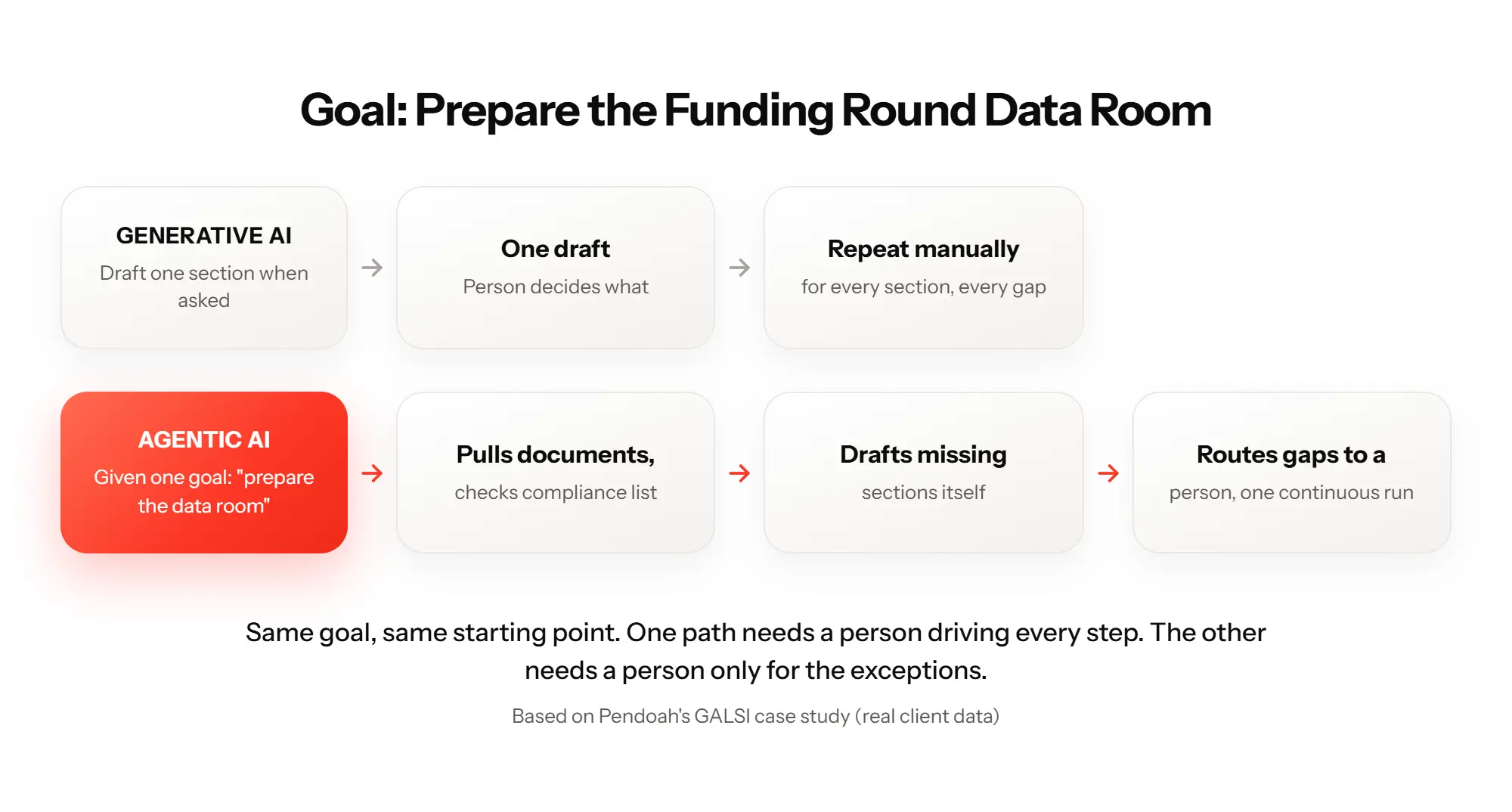
Consider a life sciences startup preparing a funding round, a real category of work Pendoah has built for. Ask generative AI to help, and it can draft a section of the pitch deck, summarize a clinical dataset, or rewrite a compliance narrative in plainer language. Each of those is a single, useful, self-contained output. Someone still has to decide what to ask for next, pull in the actual data, and assemble the pieces.
An agentic system approaches the same funding round differently: given the goal “prepare the data room,” it can pull the relevant documents from wherever they live, check them against a compliance checklist, flag the gaps, draft the missing sections, and route anything ambiguous to a person, all as one continuous process rather than a series of separate requests.
That’s close to what Pendoah actually built for GALSI, an AI co-pilot for life sciences startups that handles fundraising, validation, and regulatory compliance workflows together rather than as isolated drafting tasks. The result was a production-ready, multi-tenant platform in 8 weeks with 75% faster documentation cycles, and that speed came specifically from the orchestration, not just from generating text faster.
Real-World Use Cases by Industry
The same generative-versus-agentic split shows up across every industry, and Pendoah has built the agentic side of it more than once:
| Client | What generative AI alone would do | What Pendoah actually built | Result |
|---|---|---|---|
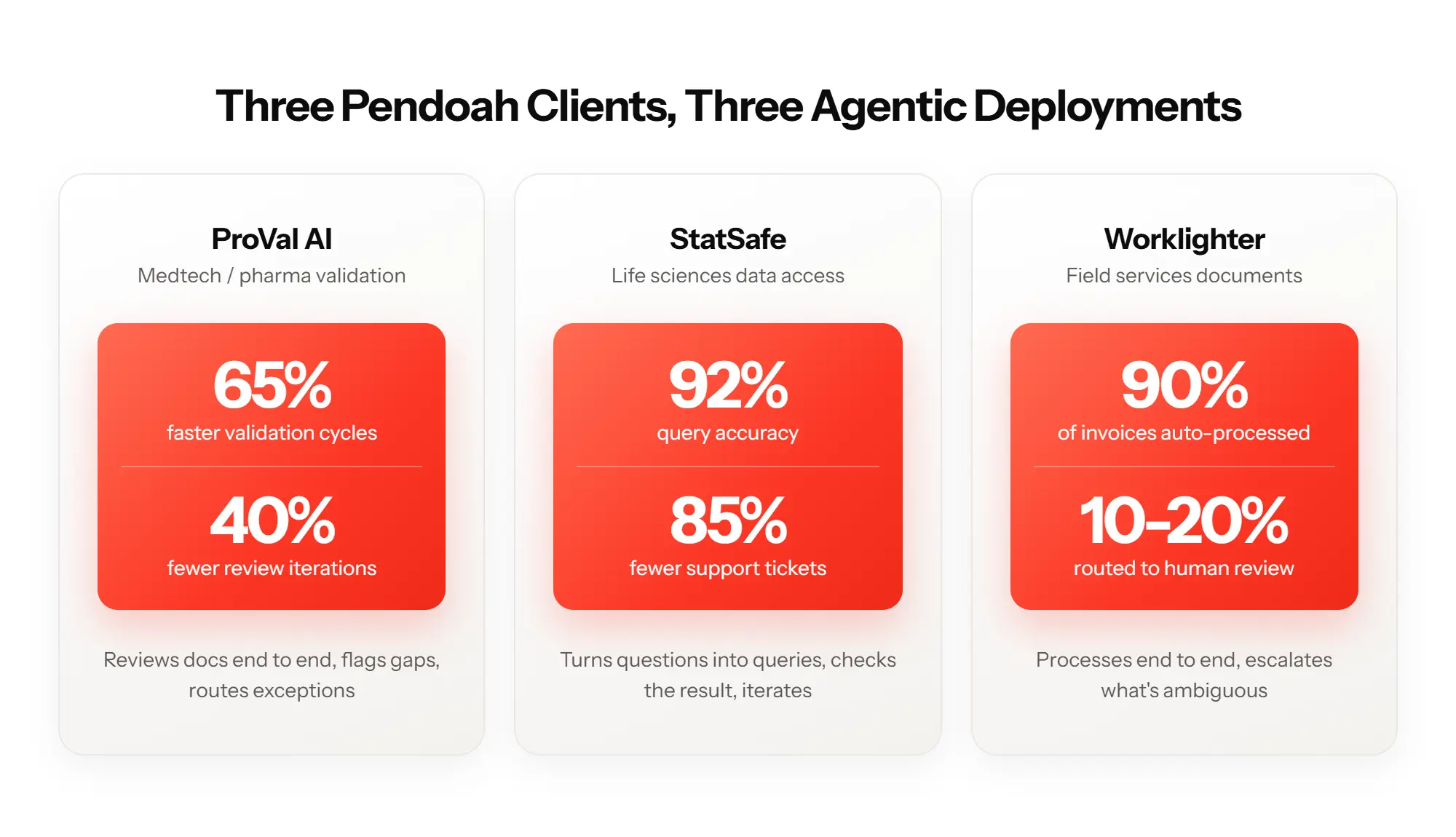
| ProVal AI (medtech, pharma validation) | Summarize one validation document at a time | Reviews documentation end to end, flags compliance gaps, and routes exceptions for review | 65% faster validation cycles, 40% fewer review iterations |
| StatSafe (life sciences data access) | Answer one data question, once | Turns a plain-English question into a query, checks the result, and iterates until it’s actually right | 92% query accuracy, 85% fewer support tickets |
| Worklighter (field services documents) | Draft a summary of a single invoice | Processes the invoice end to end and routes anything ambiguous to a person | 90% auto-processed, 10-20% routed to human review |
Notice the pattern across all three, and it’s the same one from the GALSI example above: the value didn’t come from generating better summaries or better answers. It came from the system carrying the task all the way through, checking its own work, and knowing when to hand off to a person instead of guessing.
Why the Risk Profiles Actually Diverge
This is the part most comparisons skip, and it’s the part that actually matters for how you deploy either one. Generative AI’s main risk is informational: it can hallucinate, produce biased output, or state something confidently that isn’t true. That’s a real problem, but it’s contained. A bad draft is a bad draft until someone acts on it.
Agentic AI’s risk is operational, because it acts on live systems. Databricks frames this divergence directly: generative AI poses informational risk through hallucinations and bias, while agentic AI introduces operational risk through autonomous actions on live systems, which is why agentic deployments need human-in-the-loop thresholds, provenance logging, and strict tool access controls from the outset, not added later (Databricks, Agentic AI vs Generative AI).
In practice, that means the questions you ask before deploying each one are different. For generative AI, the question is largely “is this output accurate enough to use?” For agentic AI, the question is “what is this system allowed to touch, and what happens if it acts on a wrong conclusion?” That second question is the same governance-by-design thinking behind our AI Compliance guide, and it applies with more urgency to agentic systems, precisely because they don’t just produce an answer, they act on it.
When to Use Generative AI
- The task is producing content: drafts, summaries, code, images
- A person will review the output before anything happens as a result of it
- The task doesn’t require the tool to remember state between requests
- Speed of a single output matters more than completing a multistep process
- You want to keep the system’s access surface small, since it never needs to touch live systems to do its job
When to Use Agentic AI
- The task is a multistep process with a defined end goal, not a single output
- The steps depend on each other, so the system needs to track progress and adjust
- The process would otherwise require a person to manually chain several tools or systems together
- You’re prepared to define, in advance, exactly what the system is allowed to access and act on
- You have a plan for human review of exceptions, not just a hope that it works correctly every time
Where They Work Together
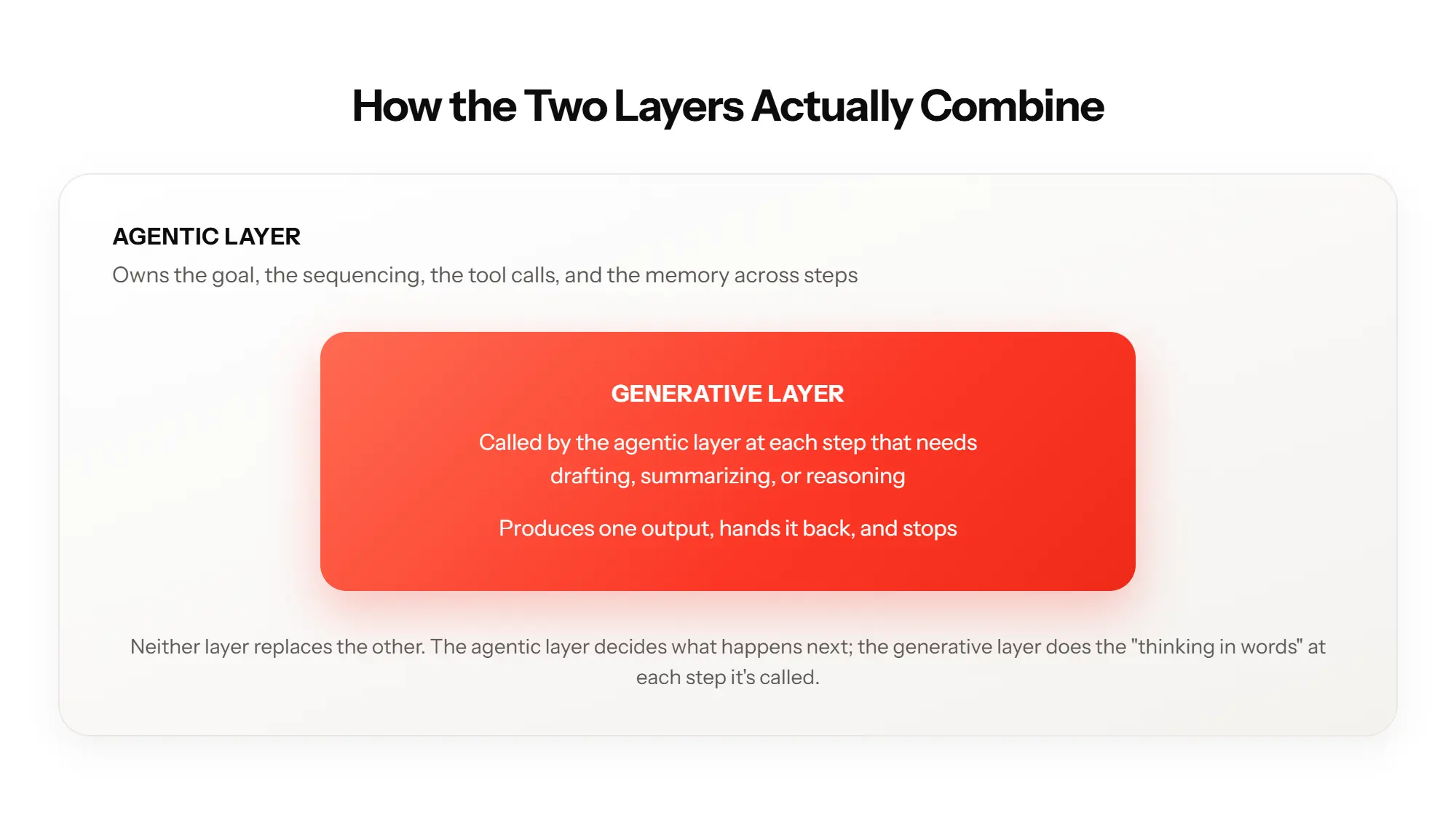
Most production agentic systems use generative AI as a component rather than a replacement for it. The agentic layer handles the goal, the sequencing, and the tool calls; a generative model handles the actual drafting, summarizing, or reasoning at each step along the way. Neither replaces the other so much as they operate at different layers of the same system.
How that layered structure actually gets built, and where AI agents specifically fit into an agentic architecture, is worth its own read: see Agents at Scale.
Key Questions to Ask Before You Choose
- Does this task end with a piece of content a person reviews, or with an action taken on a live system?
- Does the process need to track state and adjust across multiple steps, or is each request independent?
- What systems would an agentic version of this need access to, and have we scoped that access deliberately?
- If the system reaches a wrong conclusion, does it produce a bad draft, or does it take a bad action?
- Do we have a human-in-the-loop path for anything the system isn’t confident about?
The Bottom Line
Generative AI and agentic AI aren’t competing for the same job. Generative AI produces content when asked. Agentic AI pursues a goal across multiple steps, using tools and system access to get there. The distinction that actually matters for a business isn’t philosophical; it’s that agentic systems act on live systems and need to be governed that way from day one, not after something goes wrong.
Not sure which one your next AI initiative actually needs? Book a consultation with Pendoah, or look through our case studies to see how this decision played out for other clients.