Poor product-market fit contributed to 43% of startup failures examined in CB Insights’ 2026 research. The analysis covered 431 venture-backed companies that shut down since 2023, with identifiable failure reasons available for 385 of them.
Software product development can fail when businesses invest heavily in building technically advanced applications without validating customer demand, leading to low adoption and limited commercial success.
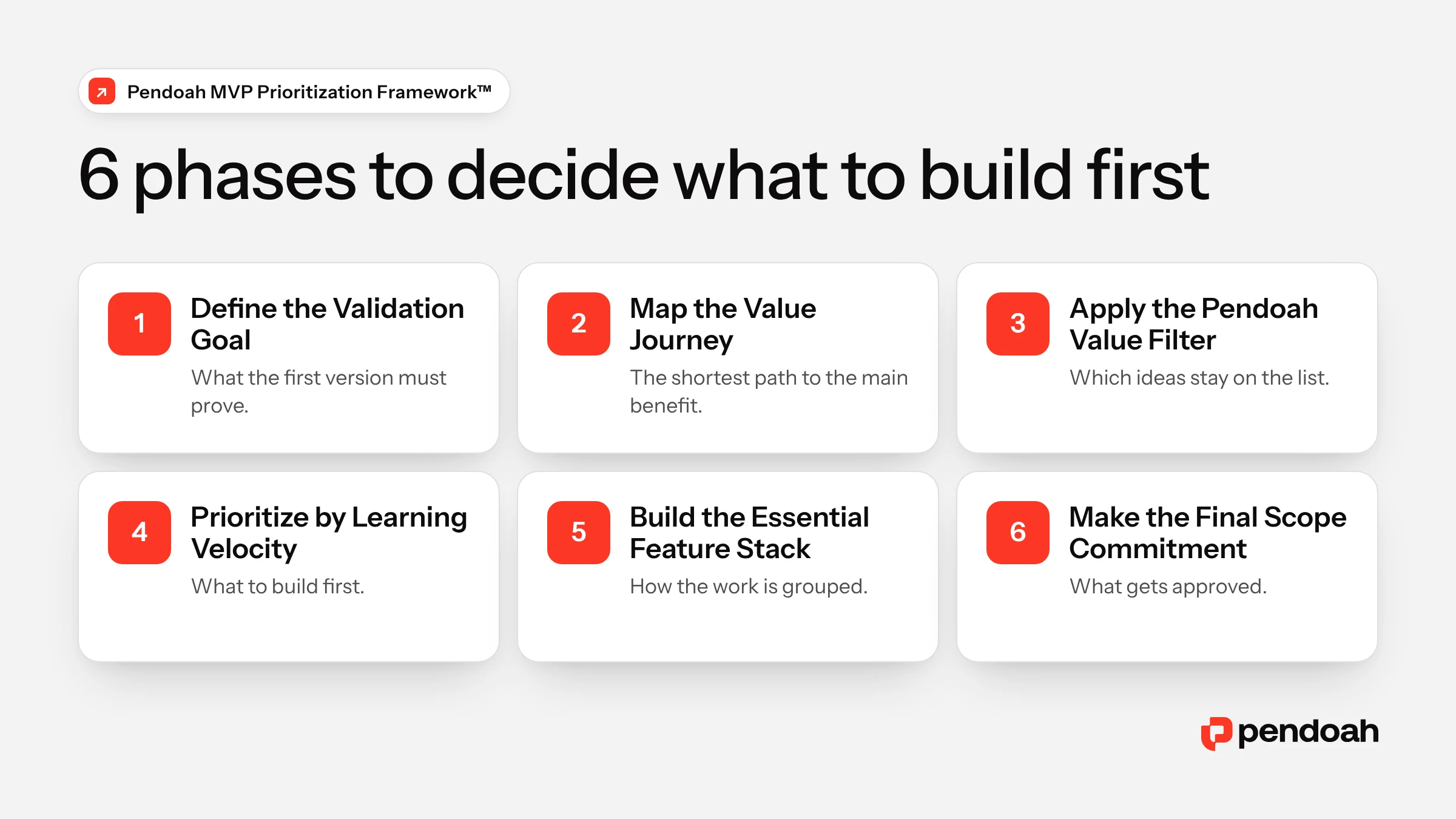
The Pendoah MVP Prioritization Framework™ is an MVP development framework with six phases for evaluating proposed features, establishing development priorities, and defining an initial product scope aligned with measurable validation objectives.
What is the Pendoah MVP Prioritization Framework™?
The Pendoah MVP Prioritization Framework™ is a step-by-step MVP feature prioritization framework for deciding which features belong in the first version of a product.
Every feature has to earn its place by helping you deliver value, prove demand, or get people using the product. However, it does not replace the five classic prioritization methods.
Each one is good at one job:
- MoSCoW sorts features into Must, Should, Could, and Won’t have.
- RICE scores ideas on Reach, Impact, Confidence, and Effort.
- Kano separates what customers expect from what delights them.
- Impact-Effort analysis finds the quick wins on a simple grid.
- User Story Mapping lays out the steps a customer takes through the product.
The trouble is that most guides hand you all five and say pick one. A busy owner shouldn’t have to become a product manager to make that call.
The Pendoah framework understands the founder’s problem and puts the best part of each method into a single order of operations. It also adds two things the classic methods leave out:
- A clear “pass-or-fail goal” before anything gets built.
- A final “remove it” test before anything gets approved.
Here’s where each familiar method shows up:
| Phase | What you decide | Borrows from | What Pendoah adds |
|---|---|---|---|
| Define the validation goal | What the first version must prove | Lean Startup’s build-measure-learn idea | A pass-or-fail number set before you build |
| Map the value journey | The shortest path to the main benefit | User Story Mapping | Only the steps a first-time user can’t skip |
| Apply the value filter | Which ideas stay on the list | Kano (what customers expect) | Four yes/no tests, including a Trust Test |
| Score learning velocity | What to build first | RICE and Impact-Effort | Ranks by what you’ll learn, not only by value |
| Build the feature stack | How the work is grouped | MoSCoW | Four layers instead of one long list |
| Final scope commitment | What gets approved | New to Pendoah | The removal test and a “later list” |
The question that runs through all six phases is simple:
What is the fastest way to prove people want this, while building as little as possible?
The Core Idea: Value, Demand, Adoption
Every feature in a first version should do at least one of three jobs:
- Deliver value. It helps the customer solve the main problem the product exists for.
- Validate demand. It helps you learn whether customers actually want what you’re offering.
- Enable adoption. It helps a new user get started and reach that main benefit quickly.
If a feature does none of these, it waits, no matter how good the idea is. There’s one more thing we never skip, and it is not a feature so much as a floor: Trust.
If people don’t feel safe handing over their email, their health details, or their credit card, they won’t use the product long enough to prove anything. Basic security and honest privacy aren’t extras. They’re the price of admission.
Throughout this article, we will use one running example, the same way we would walk a client through it.
6 Phases of the Pendoah Prioritization Framework for a Fitness App
Say a founder wants to build an AI fitness app.
The big idea: the app builds a workout plan around each person’s goals, so they don’t have to figure it out themselves. Around the table, the wish list grows fast:
- Social sharing.
- Meal plans.
- A connection to smartwatches.
- A community forum.
- Video coaching.
All of those might be worth building one day, but the first version only has to answer one question: will people use a workout plan written by AI? Everything else can wait until the answer is yes.
Phase 1: Define the Validation Goal
This is where the framework works as an MVP validation framework. We start by writing down what the first version has to prove.
- What’s the one assumption that could make or break this entire idea?
- What problem are we solving, and for whom?
- What should the customer be able to do by the end of their first visit?
The answers should give you a clear picture of the customer, the problem, and the assumption that must be proven for the idea to succeed.
For the fitness app, the big assumption might be:
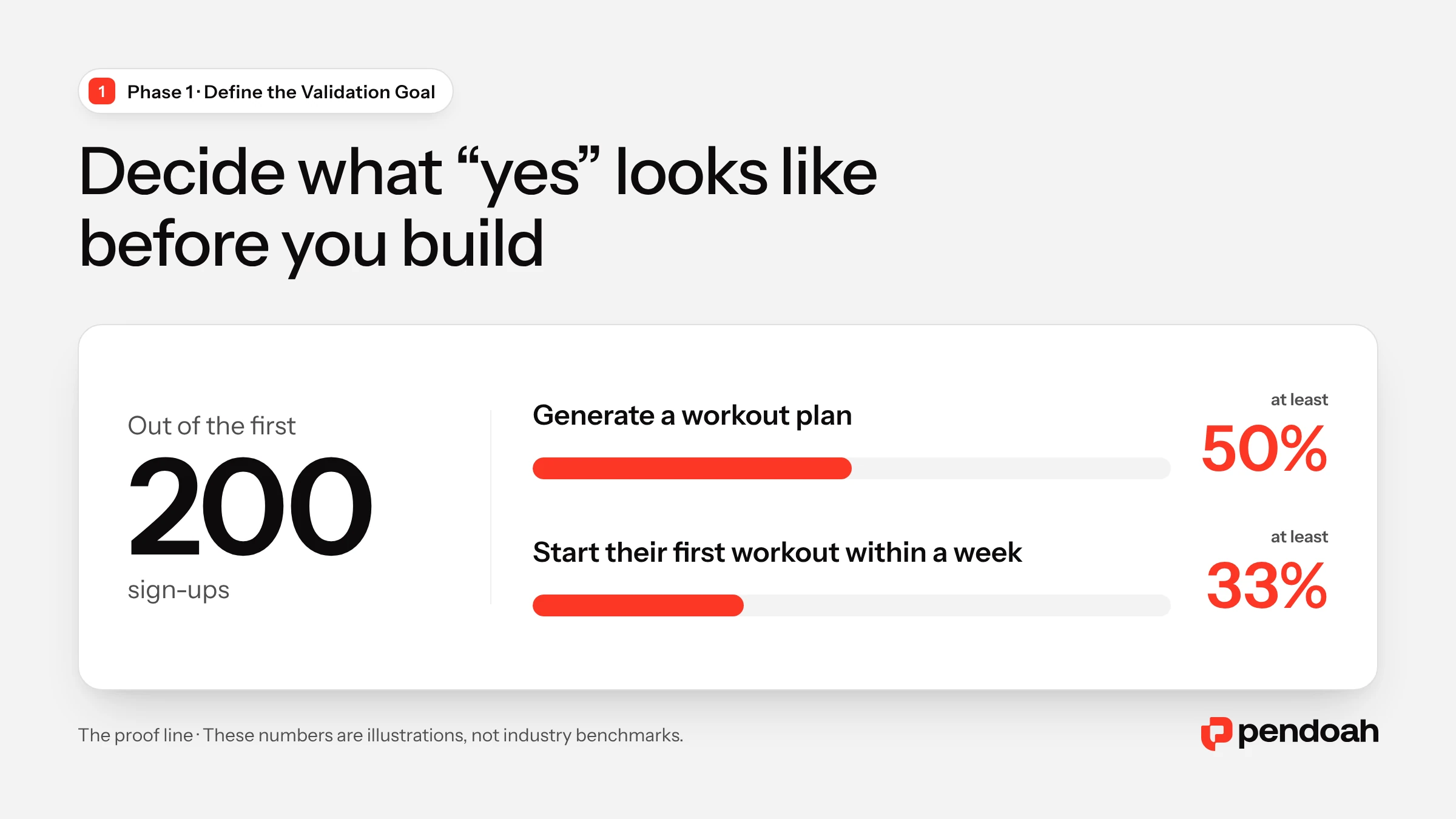
But an assumption alone is not enough. Decide what “yes” looks like before you build. Pick the number that would convince you and write it down where everyone can see it.
We call this the proof line.
Example: Out of the first 200 sign-ups:
- At least 50% generate a workout plan
- At least 33% start their first workout within a week
These numbers are illustrations, not industry benchmarks. Your proof line should reflect your budget, your market, and what you’d need to see to keep investing.
Why It Matters
Two hundred sign-ups sound great until you notice that only nine people have ever finished a workout. Without a proof line, it’s easy to misinterpret results.
- Sign-ups tell you the ad worked.
- Product usage tells you the product did.
Phase 2: Map the Value Journey
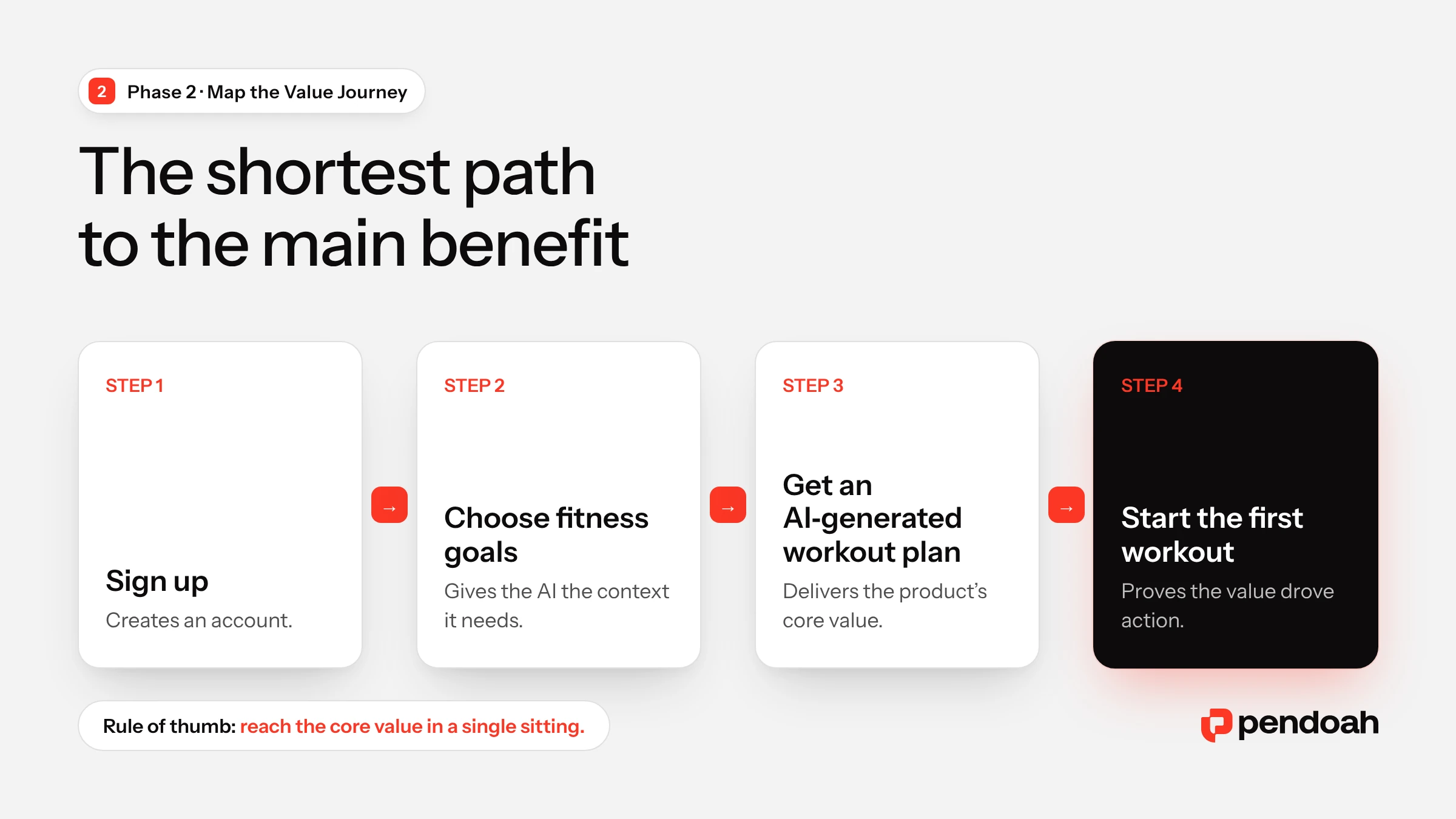
Next, identify the few essential actions a new customer must take to experience the core value of your product. Focus on what they need to do, not every feature, option, or screen you could build.
For the fitness app, that journey is just four steps:
- Sign up.
- Choose fitness goals.
- Get an AI-generated workout plan.
- Start the first workout.
Every step earns its place.
- Sign up creates an account.
- Choose fitness goals gives the AI the context it needs.
- Get a workout plan delivers the product’s core value.
- Start a workout proves that the value was compelling enough to drive action.
Keeping the journey short has another advantage: it makes problems easier to spot.
If plenty of people sign up but very few finish choosing their goals, the issue is probably the onboarding experience, not the idea itself. When the path is simple, bottlenecks become obvious, making them easier to fix.
A useful rule of thumb is that a first-time user should reach the product’s core value in a single sitting.
If the journey cannot fit into a coffee break, it’s probably too long for the first version. The faster customers reach value, the faster you learn whether the product deserves further investment.
Phase 3: Apply the Pendoah Value Filter
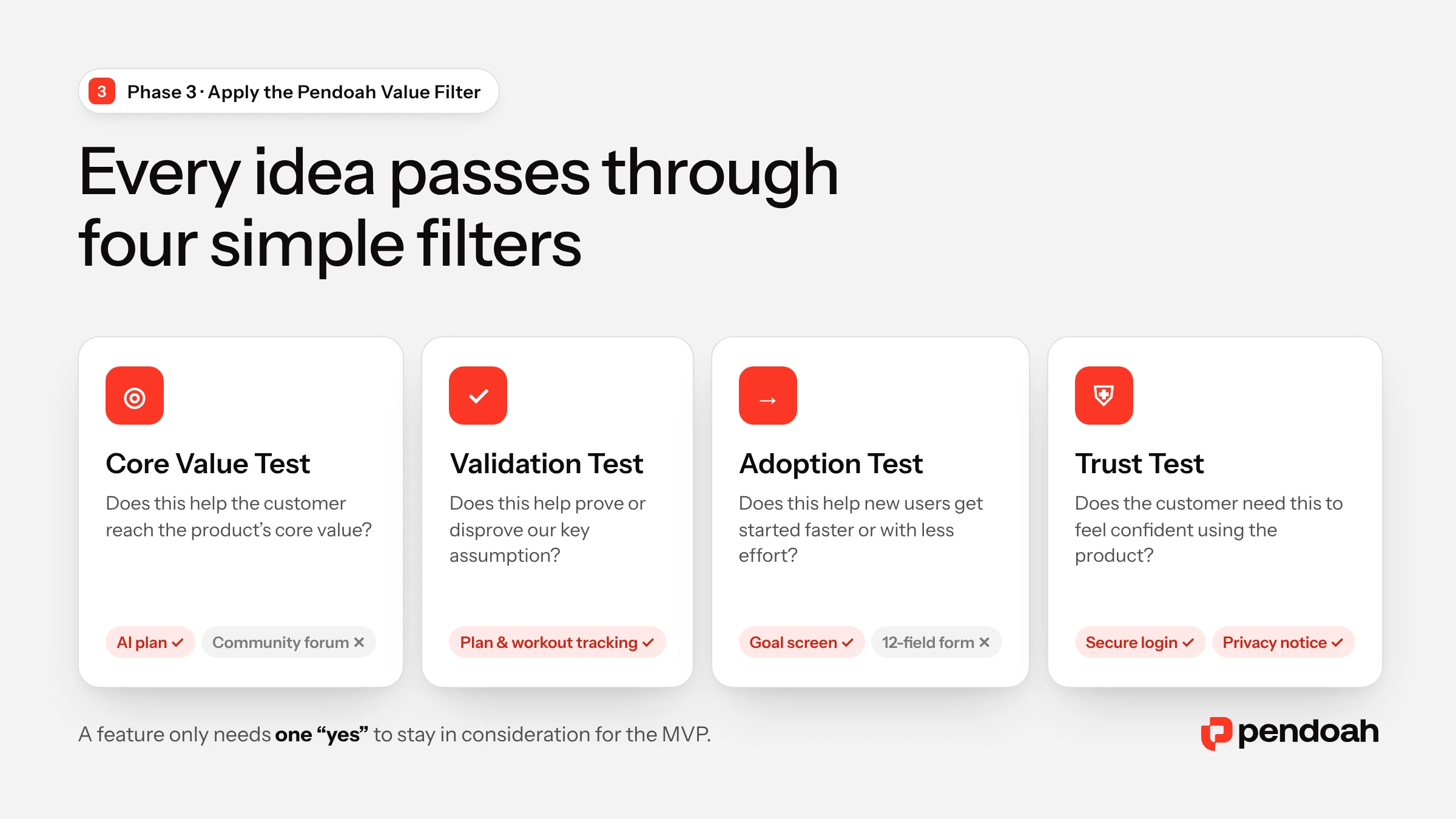
Now it’s time to look at the full wish list.
Every idea, feature, and enhancement should pass through four simple filters. A feature only needs one “yes” to stay in consideration for the MVP.
| Test | Question | Fitness App Example |
|---|---|---|
| Core Value Test | Does this help the customer reach the product’s core value? | An AI-generated workout plan: Yes. A community forum: No, users can achieve the core outcome without it. |
| Validation Test | Does this help prove or disprove our key assumption? | Tracking who generates a workout plan and who starts a workout: Yes. |
| Adoption Test | Does this help new users get started faster or with less effort? | A simple goal selection screen: Yes. A 12-field registration form: No, it creates friction. |
| Trust Test | Does the customer need this to feel confident using the product? | Secure login, clear privacy notice, and control over personal health data: Yes. |
The goal isn’t to build everything that passes. The goal is to identify what deserves further consideration.
If a feature receives four “no” answers, it doesn’t belong in the first version. Remove it from the MVP backlog and revisit it later if customer demand justifies the investment.
A feature that passes one or more tests hasn’t earned a place in the product yet. It has only earned a place in the conversation. The next phase determines what gets built first.
Phase 4: Prioritize by Learning Velocity
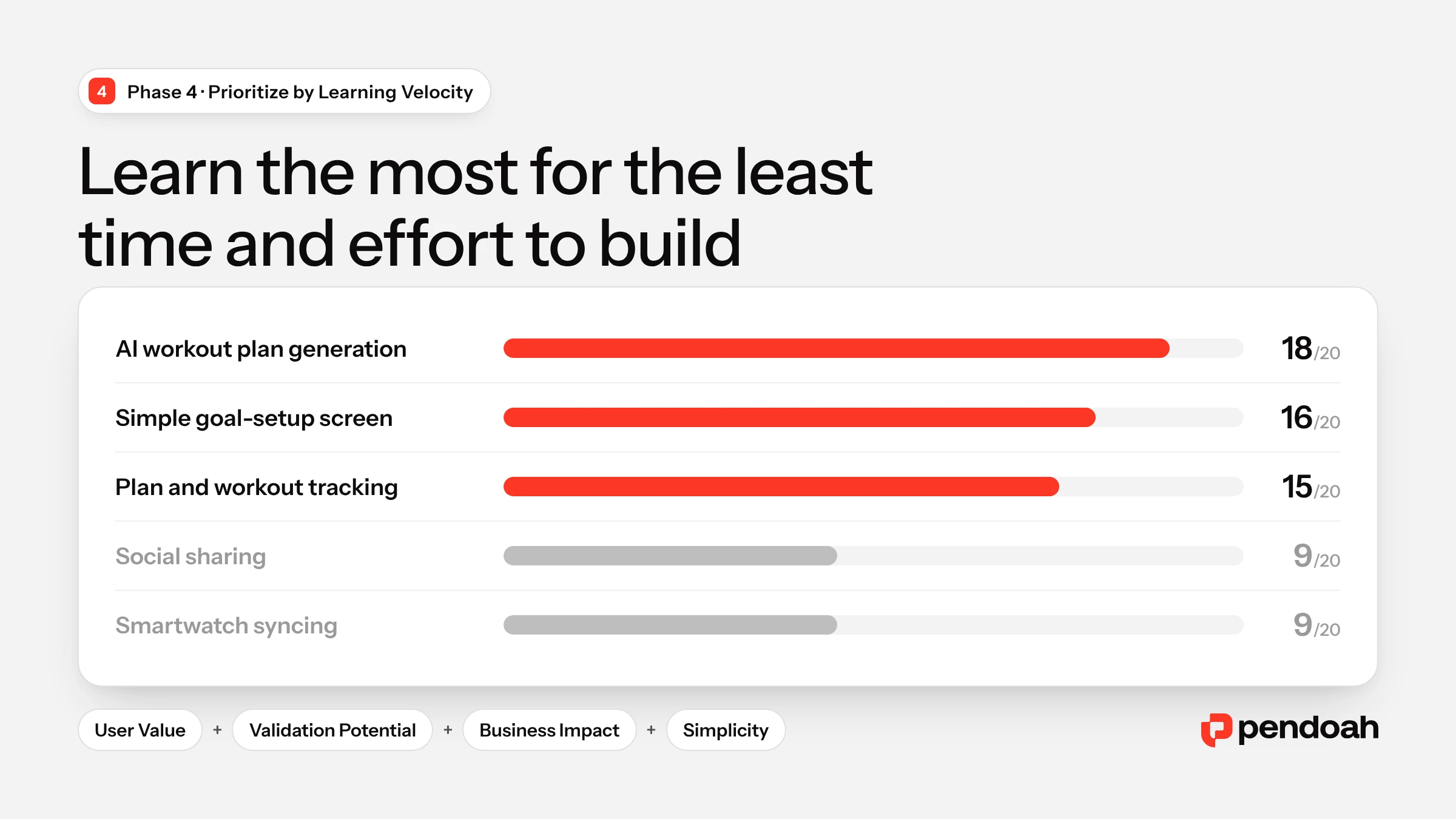
This is the heart of the Pendoah Framework and where it differs from most prioritization methods.
Traditional frameworks rank features based on how valuable they might be to customers. That approach works well for established products with real usage data and paying customers.
Early-stage products have a different challenge: you don’t need maximum value yet; you need maximum learning.
The question isn’t:
“Which feature sounds most valuable?”
It’s:
“Which feature helps us learn the most while taking the least time and effort to build?”
We call that learning velocity.
The idea comes from the Lean Startup principle that every early release is an experiment. We’ve simply turned that principle into a practical scoring system teams can use during prioritization sessions.
Score each remaining feature from 1 to 5 across four dimensions:
| Factor | Question |
|---|---|
| User Value | How much does it help the customer solve their main problem? |
| Validation Potential | How much does it help test the core assumption behind the product? |
| Business Impact | How much does it support a key business goal, such as sign-ups, activation, or paid conversions? |
| Simplicity | How easy is it to build? (5 = a few days of work, 1 = several months) |
Add the four scores together. The highest totals usually belong at the top of the MVP backlog.
For the fitness app, the scoring might look like this:
| Feature | User Value | Validation | Business Impact | Simplicity | Total |
|---|---|---|---|---|---|
| AI workout plan generation | 5 | 5 | 5 | 3 | 18 |
| Simple goal-setup screen | 4 | 4 | 3 | 5 | 16 |
| Plan and workout tracking | 2 | 5 | 4 | 4 | 15 |
| Social sharing | 2 | 1 | 3 | 3 | 9 |
| Smartwatch syncing | 3 | 2 | 3 | 1 | 9 |
The scores tell a useful story. The features at the top sit there because they deliver core value, test the key assumption, and support business goals directly.
To make these trade-offs even easier to see, plot each feature on the Pendoah Learning Matrix, which compares:
- Learning gained
- Effort required
Features that generate the most learning with the least effort should typically be built first.
One caveat: the matrix is a guide, not a rulebook.
Some features score poorly on learning velocity and still need to be built because the product cannot function without them. Authentication, payment processing, or basic account management often fall into this category.
The goal is not to build only high-scoring features, but the smallest set of features that deliver value, validate demand, and create the next learning opportunity.
Phase 5: Build the Essential Feature Stack
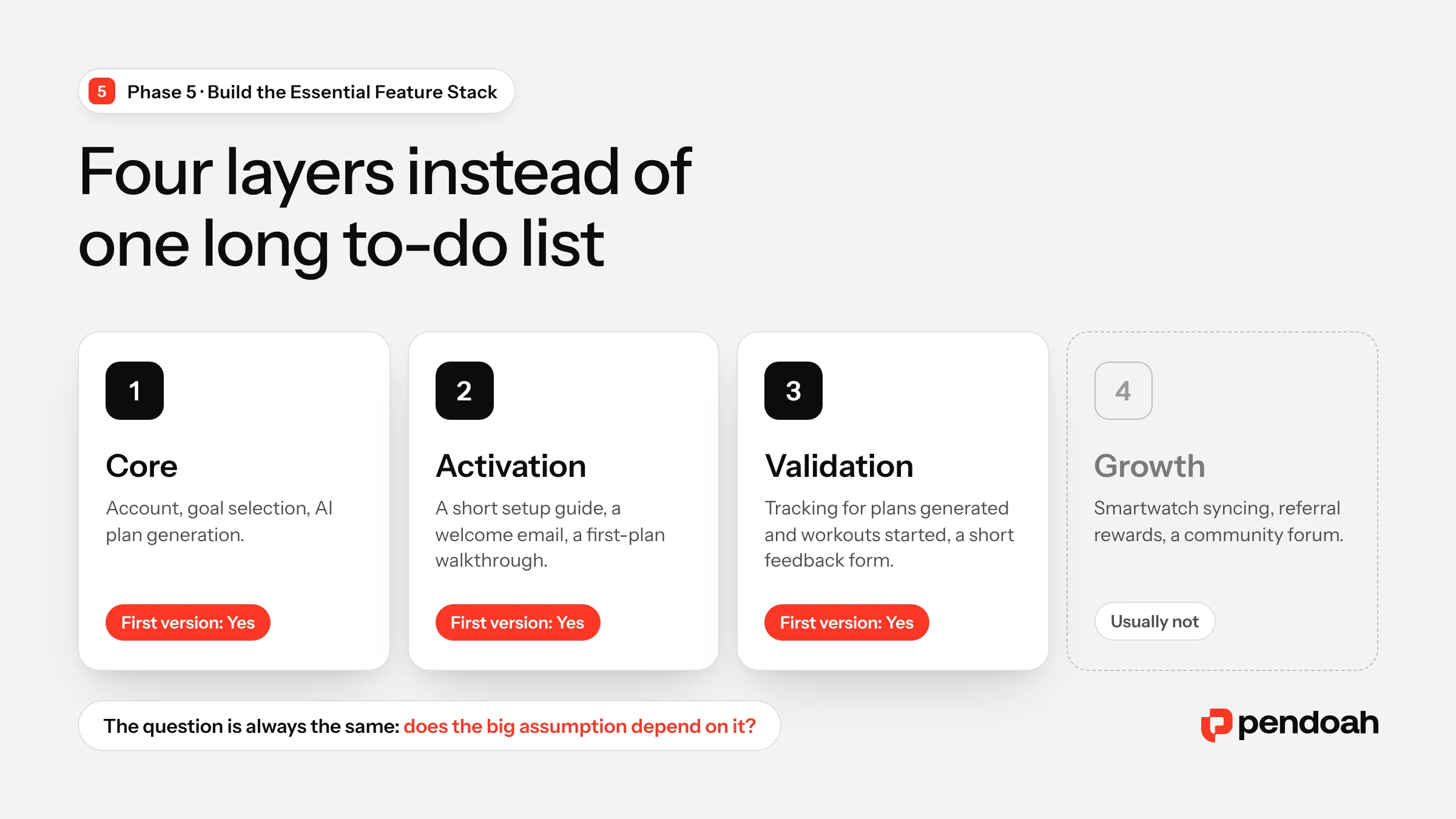
Now sort the ranked list into four layers instead of one long to-do list. Layers make it obvious what has to ship together and what can follow later.
| Layer | What it’s for | Fitness app example | In the first version? |
|---|---|---|---|
| Core | The product can’t deliver its benefit without these | Account, goal selection, AI plan generation | Yes |
| Activation | Help new users reach the benefit faster | A short setup guide, a welcome email, a first-plan walkthrough | Yes |
| Validation | Help you measure what’s happening | Tracking for plans generated and workouts started, a short feedback form | Yes |
| Growth | Help the product grow once it’s proven | Smartwatch syncing, referral rewards, a community forum | Usually not |
Layers 1 to 3 make up the first version. Together, they give you everything needed to deliver value, validate demand, and measure results. Layer 4 waits until the proof line has been met.
That said, the layers depend on the business. For a fitness app aimed at running clubs, community features might be the whole point. In that case, they belong to Layer 1, not Layer 4.
The question is always the same: does the big assumption depend on it?
What you walk away with: a clear feature plan that separates what must ship to validate the idea from what can wait until demand is proven.
Phase 6: Make the Final Scope Commitment
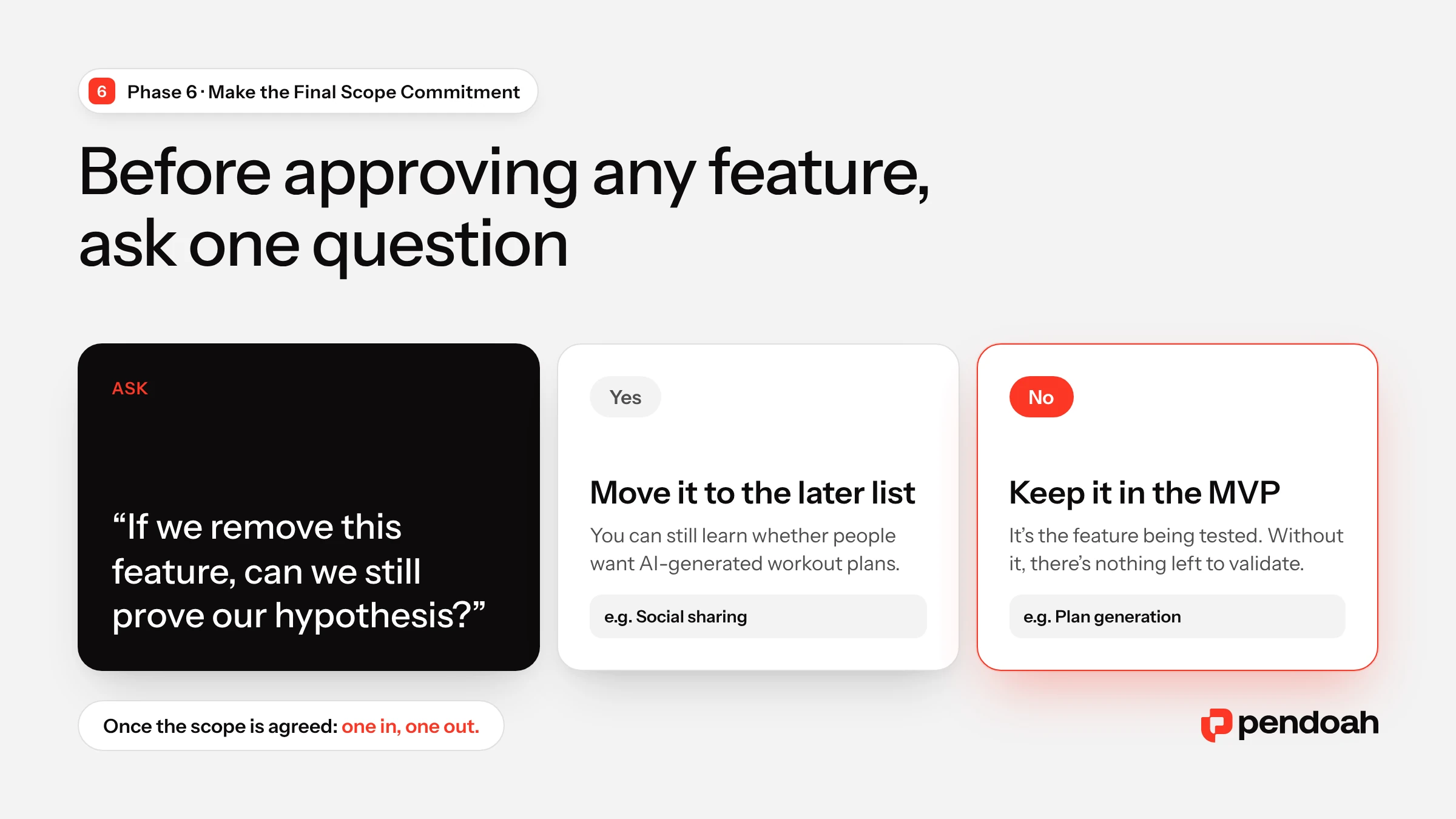
This is the last line of defense against scope creep, the slow accumulation of “just one more feature” that pushes launches further and further away.
Before approving any feature, ask one question:
If we remove this feature, can we still prove our hypothesis?
- If the answer is yes, move it to the later list.
- If the answer is no, keep it in the MVP.
For the fitness app, social sharing can be removed because you can still learn whether people want AI-generated workout plans. Plan generation cannot be removed because it’s the feature being tested. Without it, there’s nothing left to validate.
The key is to stay focused on learning, not completeness. The first version does not need every feature customers might eventually want. It only needs the features required to deliver value and test the core assumption.
Two guardrails keep this process honest:
- Trust-related features are never removed simply because they don’t validate a hypothesis. Security, privacy, and legal requirements are important.
- The later list is a real list. Every removed feature should be documented, along with why it was postponed and what evidence would justify bringing it back.
Once the scope is agreed, follow a simple rule:
One in, one out.
If a new feature must be added, another feature of a similar size comes out. The only exceptions are new evidence from users or non-negotiable requirements such as legal, compliance, or security fixes.
Personal preferences don’t count.
What you walk away with: a protected MVP scope that stays focused on delivering value and proving demand.
How is the Pendoah Framework Different?
The Pendoah framework flips the order. It starts with the proof and works backward to the features. Four things make it our own:
The Proof Line
A pass-or-fail number agreed before a single feature is built.
The Trust Test
Security and privacy treated as a requirement, not something you get to later.
The Learning Velocity Score
Features ranked by what they teach you, not only by what they’re worth.
The Removal Test and the Later List
A final check that keeps scope tight without throwing good ideas away.
The result is a first version that’s smaller, cheaper, and faster to launch, and one that answers the question you built it to answer.
Five Mistakes We See Most Often
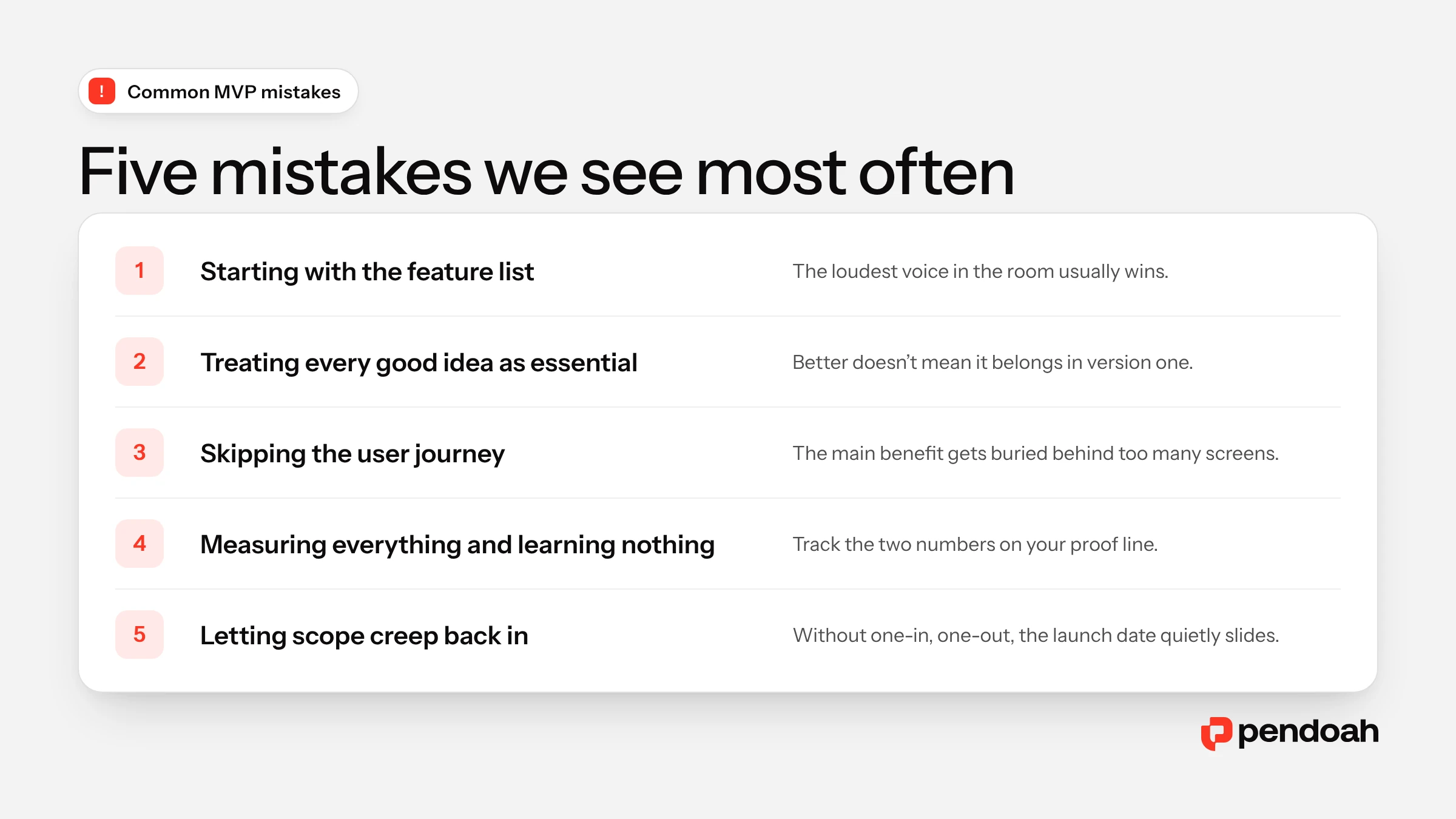
These five common mistakes can make an MVP more complicated, delay its launch, and make it harder to learn what users need. Here’s what to watch out for and how to avoid them.
- Starting with the feature list. If you debate features before agreeing on what the product must prove, the loudest voice in the room usually wins.
- Treating every good idea as essential. A feature can make the product better and still not belong in version one.
- Skipping the user journey. You can have all the right features and still bury the main benefit behind too many screens.
- Measuring everything and learning nothing. Tracking 60 numbers feels thorough. Tracking the two numbers on your proof line is what tells you whether to keep going.
- Letting scope creep back in. Every “quick addition” costs time. Without the one-in, one-out rule, the launch date quietly slides.
A Quick Checklist for Every Feature
Run each feature through these questions before it goes into the first version:
- Does it help the customer get the main benefit?
- Does it help us test our big assumption?
- Does it help new users get started faster?
- Do customers need it to feel safe using the product?
- What will we learn from it, and is that tied to our proof line?
- Roughly how long will it take to build?
- If we removed it, could we still prove our hypothesis?
A feature doesn’t need to tick every box. But every feature in the first version should have a clear, written reason for being there.