Five different terms show up in almost every AI vendor conversation now, often describing the same demo. Gartner reports that task-specific AI agents were built into fewer than 5% of enterprise applications in 2025, and forecasts that to reach 40% by the end of 2026, an 8x jump in a single year (Gartner, 2025 press release). The same firm also predicts that over 40% of agentic AI projects will be canceled by the end of 2027, mostly from escalating costs and unclear business value (Gartner, 2025 agentic AI press release).
Both predictions are about the same underlying shift, and a good chunk of that cancellation rate traces back to the same root cause: nobody clarified which one the project needed.
The One Thing All Five Terms Have in Common
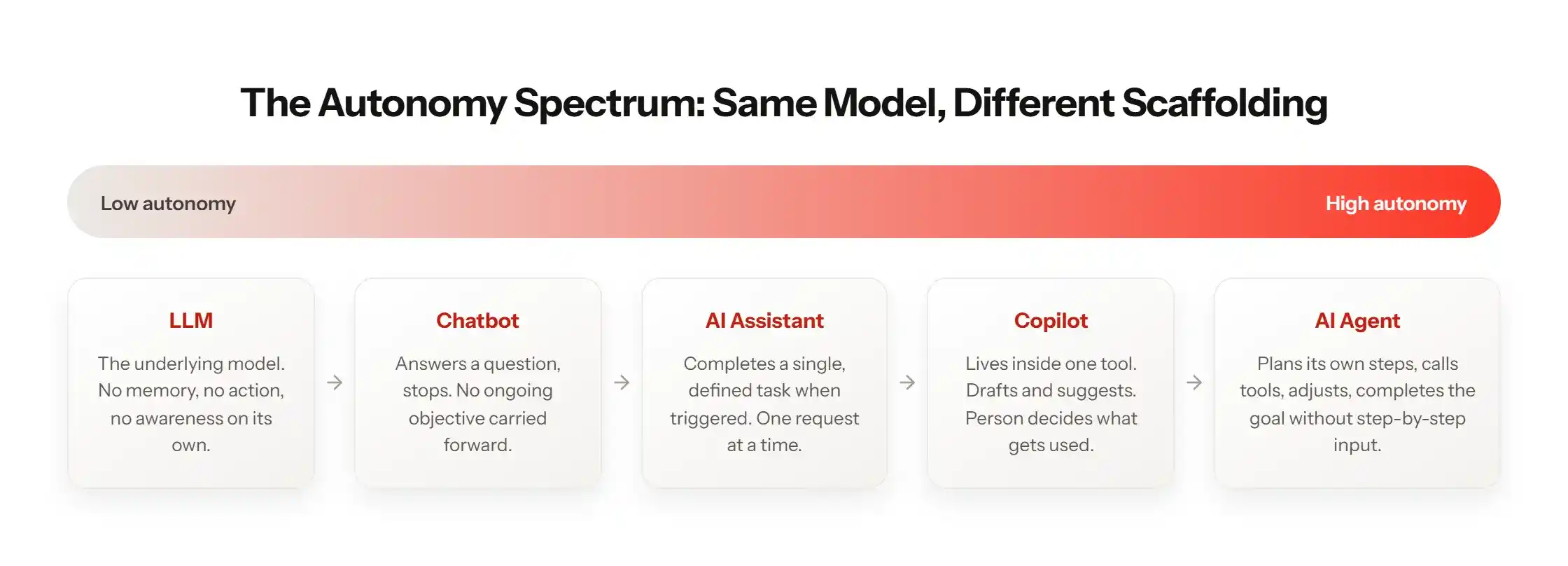
LLM, a large language model, isn’t a product category at all. It’s the underlying technology that predicts the next word in a sequence of text. A chatbot, an assistant, a copilot, or an agent are all typically built on top of an LLM. None of them are an alternative to it.
That distinction matters because it clears up the most common confusion in this space:
Should we use an LLM or an agent is a bit like asking if we should use an engine or a car.
The other terms describe:
- What gets built around the model, specifically how much autonomy it has
- Whether it remembers anything between interactions
- Can it use tools to take actions
- How much oversight it needs
Those four questions are the actual axis this comparison runs on.
AI Agent vs. Chatbot vs. Assistant vs. Copilot: Side by Side
| Chatbot | AI Assistant | Copilot | AI Agent | |
|---|---|---|---|---|
| Primary job | Answer questions in conversation | Complete simple tasks on request | Suggest and draft inside your workflow | Complete a multistep goal autonomously |
| Autonomy | None, responds when prompted | Low, acts only when asked | Low, drafts but you approve | High, plans and executes its own steps |
| Memory | Usually none across sessions | Limited, remembers preferences | Contextual to the current file or task | Maintains state across the whole task |
| Tool use | Rarely, mostly text in and out | Sometimes, single-step actions | Embedded in one tool, doesn’t leave it | Calls multiple tools and systems |
| Who owns the final action | The person reading the answer | The person triggering the task | The person reviewing the draft | The agent, within defined guardrails |
| Oversight needed | Minimal | Light | Light to moderate | Substantial, built in from the start |
What is an LLM?
A large language model is trained on huge volumes of text to predict what word, or part of a word, comes next given everything that came before it. That’s the whole mechanism underneath every one of the other four terms. It has no memory of you by default, no ability to act on anything, and no awareness that a conversation happened once the session ends, unless something is built around it to add those things.
That’s the piece worth sitting with: a raw LLM is closer to a very capable autocomplete than to any of the products people compare it against.
- A chatbot wraps an LLM in a conversational interface.
- A copilot wraps it in a specific tool’s workflow.
- An agent wraps it in planning logic, memory, and tool access.
The model itself doesn’t change much between these; the scaffolding built around it does.
What is a Chatbot?
A chatbot answers a question and stops. It might be scripted, retrieving from a knowledge base, or generating a response with an LLM underneath, but the interaction pattern is the same: you ask, it answers, the conversation doesn’t carry an ongoing objective forward.
A chatbot on a support page answering “what are your hours” is doing exactly what it’s built for. Ask it to actually change your appointment, and you’ve stepped outside what a chatbot, by definition, does.
What is an AI Assistant?
An assistant sits one step past a chatbot: it can complete a defined task when asked, not just answer a question about it. Set a reminder, check tomorrow’s weather, add an item to a list. The distinction from an agent is that an assistant acts when triggered and generally handles one discrete request at a time. It’s reactive to a task rather than only a question.
What is a Copilot?
A copilot lives inside a specific tool and stays there. It watches what you’re doing and offers a suggestion, a draft, a completion, but you decide what gets used.
GitHub Copilot is the clearest example, and it’s also one of the better-measured ones: in a controlled experiment with 95 developers, the group using Copilot completed a standardized coding task 55.8% faster than the control group, a statistically significant result published by GitHub and later peer-reviewed (Peng et al., arXiv:2302.06590).
That number is real, and it’s also a useful illustration of what a copilot is good at: making an expert faster at something they already know how to do, not taking the task off their plate entirely.
What is an AI Agent?
An agent is the one entry on this list that acts without being walked through each step. Give it a goal, and it plans the sequence, calls whatever tools or systems it needs, checks its own progress, and adjusts if something along the way doesn’t go as expected.
Gartner’s own framing captures the practical shift well: adding task-specialization capability is what evolves an assistant into an agent, the same underlying model, but now with the tools and autonomy to actually finish something rather than just suggest it.
That’s also exactly why agents carry more risk than the other three. An agent that reaches a wrong conclusion doesn’t just produce a bad suggestion someone reviews before it matters. It can act on that conclusion directly, which is the same distinction we cover in more depth in Agents at Scale.
Why Governance Requirements Change as You Move Right
As you move from chatbot to assistant to copilot to agent, oversight requirements don’t rise gradually; they spike at the agent stage, because that’s when the system starts acting on other systems rather than just producing text for a person to review first.
- A chatbot that hallucinates gives someone a wrong answer they can fact-check.
- An agent that hallucinates can update the wrong record, send the wrong email, or take action that must be manually reversed.
That’s a large part of why Gartner’s cancellation forecast and adoption forecast are really describing the same underlying problem from two sides: the technology is spreading fast, and a meaningful share of it is being deployed without the access controls, audit trails, and human-in-the-loop thresholds that agentic autonomy actually requires.
We cover the access-control and audit-trail side of that in Layered Governance Architecture. The short version either way: the governance work must happen before the agent goes live, not after it’s already taken an action someone has to explain, the same human in the loop principle that applies to every autonomous system, not just this one.
Where Pendoah Has Built Across This Spectrum
Pendoah’s own case studies land at different points on this same spectrum, which is a useful way to see the distinction in practice rather than in the abstract.
StatSafe behaves closer to an assistant: it takes a plain-English question and turns it into a database query, a single defined task completed on request, with 92% query accuracy.
GALSI sits further along, closer to a copilot that’s started taking on agent-like orchestration: it drafts fundraising and compliance documentation but also pulls together the pieces of a full data room rather than answering one request at a time.
Worklighter sits furthest toward agent territory: its document-automation engine plans its way through an entire invoice, from intake to entry to exception routing, auto-processing 90% of them without a person walking it through each step.
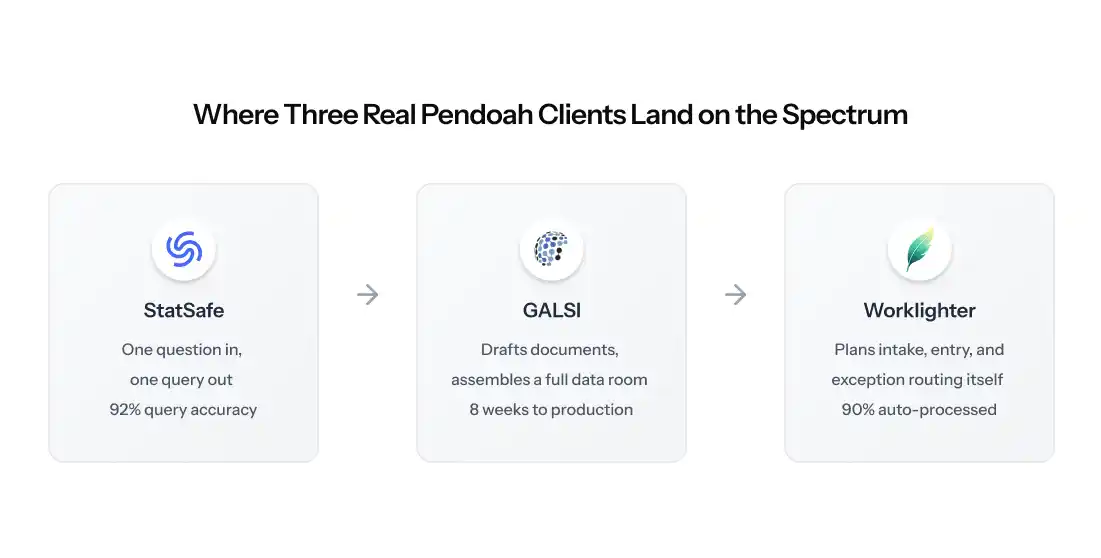
They’re built for different points on the same autonomy scale, and that’s the actual decision in front of most teams evaluating this space: not which term sounds more advanced, but which point on the spectrum the task in front of them requires.
Which One Does Your Project Actually Need?
- If the goal is answering common questions consistently, you need a chatbot, or completing simple requests on request, an assistant, or making an expert faster at their own work, a copilot. That’s the range Pendoah’s Conversational AI Development Services are built around.
- If the goal is completing a multistep process end to end, with defined guardrails for when it should stop and ask, you need an agent, and you need the governance work done before it launches, not after. That’s the specific territory Pendoah’s Agentic AI Development service is built for.
Key Questions to Ask Before You Build or Buy
- Does this tool need to remember anything between interactions, or is each request independent?
- Does it need to take action on a live system, or only produce something a person reviews first?
- If it reaches a wrong conclusion, does that produce a bad answer or a bad action?
- Who is accountable for what it does once it’s live, and has that been defined before launch?
- Are we choosing this category because the task requires it, or because the term sounds more advanced?
The Bottom Line
These five terms aren’t a ladder where each one is simply “more advanced” than the last. They’re different answers to how much autonomy, memory, and tool access a task actually needs, and the governance requirement changes sharply once you cross into agent territory.
Picking based on which word sounds most impressive is exactly how Gartner’s cancellation forecast keeps proving itself right.
Not sure which point on this spectrum your project actually needs? Book a consultation with Pendoah, or look through our case studies to see how this decision played out for other clients.