If you’re scoping a healthcare app in 2026, you already know the pressure: PHI has to be protected, HIPAA isn’t optional, and every vendor you talk to says some version of “we’re HIPAA compliant” like that settles the question. It doesn’t. If your app diagnoses, monitors, or influences a treatment decision, the FDA may have a say too, and that’s a separate, often-overlooked conversation most healthcare app guides skip entirely.
Here’s what actually governs healthcare app development, treated as two separate questions instead of one checklist.
The Two Regulatory Questions Every Healthcare App Has to Answer
Every healthcare app needs a clear answer to two separate questions, and conflating them is where a lot of projects lose time and money. The first: does the app create, store, or transmit protected health information, PHI, on behalf of a covered entity like a hospital or clinic? If yes, HIPAA applies, regardless of what the app actually does. The second, entirely different question: does the app diagnose, treat, mitigate, or otherwise perform a medical function, and would a malfunction put a patient at risk? If yes, the FDA may classify it as a medical device, which is a different regulatory pathway with different requirements entirely.
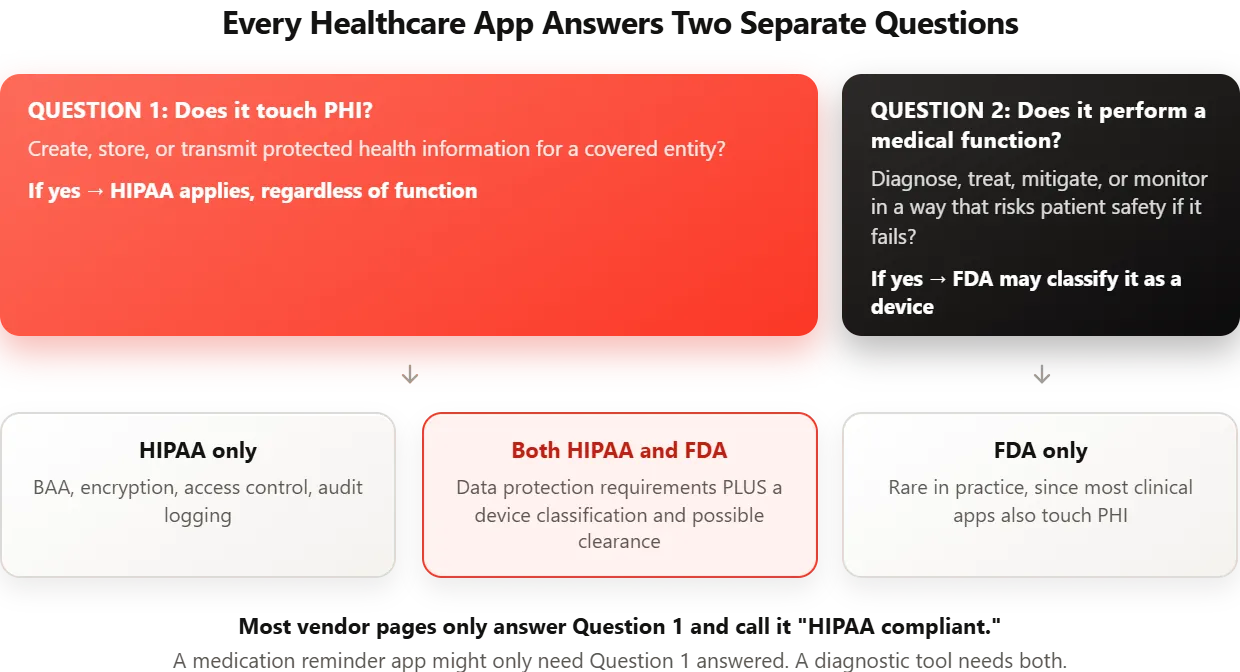
A medication reminder app might touch PHI and need a Business Associate Agreement, but never need FDA review. A diagnostic imaging tool might need FDA clearance even if it never stores a single patient record on its own servers. Most vendor pages collapse these into one “we’re HIPAA compliant” claim, which answers the first question and says nothing about the second.
PHI Protection: What HIPAA Actually Requires
If your app touches PHI, a few requirements aren’t optional, and the Department of Health and Human Services’ Office for Civil Rights enforces the HIPAA Security Rule specifically because electronic systems create risk categories that don’t exist on paper (HHS.gov, Summary of the HIPAA Security Rule):
- A signed Business Associate Agreement with any software development services partner or vendor that will handle PHI, executed before any real data is shared, not after development starts.
- Encryption for data at rest and in transit, typically AES-256 for stored data and TLS for anything moving between the app and a server.
- Strong authentication, usually multi-factor, since a compromised single-factor login is one of the most common paths to a PHI breach.
- Role-based access control, so a patient, a front-desk staffer, and a clinician see only the data relevant to their role, not the same view of the system.
- Audit logging of who accessed what PHI and when, detailed enough to reconstruct what happened if something goes wrong.
- A defined breach notification process, since HIPAA sets specific timelines for notifying affected individuals and HHS if PHI is exposed.
None of this is unique to mobile or web apps specifically, but apps introduce their own version of each requirement: local device storage needs its own encryption, session timeouts need to account for a phone being left unlocked on a nightstand rather than a workstation in a locked office, and remote wipe capability matters in a way it doesn’t for a server-side system nobody carries in their pocket. We cover the same governance-by-design principle for AI systems more broadly in our AI Compliance guide, and the same logic applies here: build the protections in from the start, not after a security review flags a gap.
When Does a Healthcare App Need FDA Clearance?
This is the part most healthcare app guides skip, and it’s worth understanding even if your specific app ends up not needing it. The FDA’s own guidance is clear that not every health-related app is a regulated medical device: software functions that pose low risk and don’t meet the legal definition of a device generally fall under the FDA’s enforcement discretion, meaning the agency doesn’t intend to actively regulate them, even though they technically could (FDA, Device Software Functions Including Mobile Medical Applications).
What tips an app into needing FDA review is whether it performs a genuine medical function, diagnosis, treatment, mitigation, or prevention of disease, where a malfunction could put a patient at risk. The FDA classifies that software using a three-tier risk system:
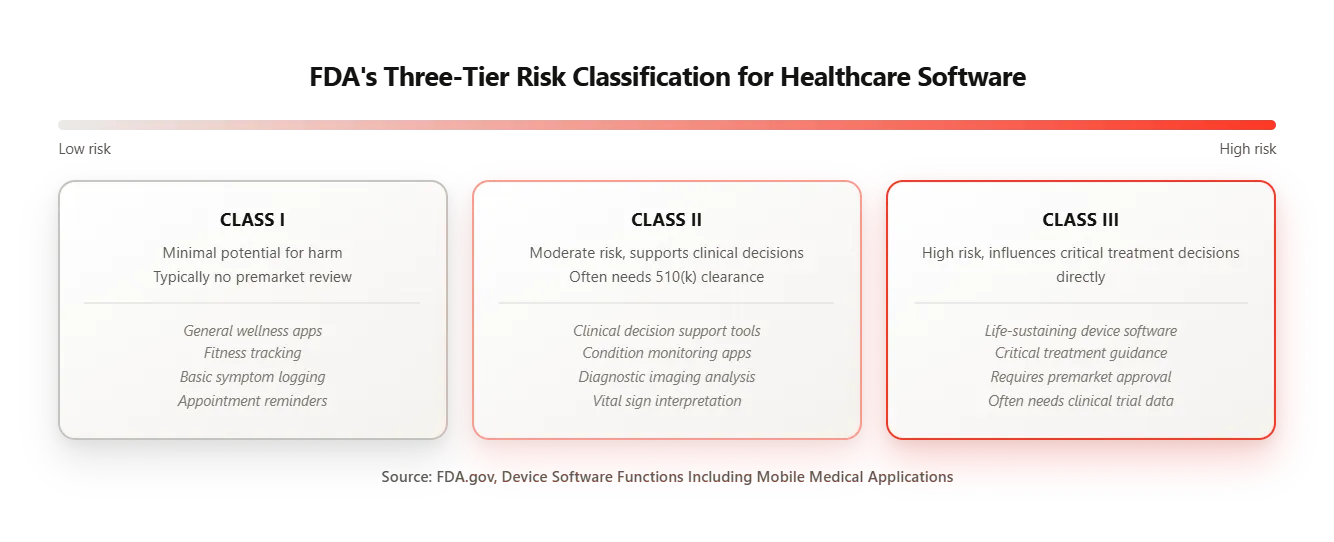
- Class I: low-risk software with minimal potential for harm, most general wellness and fitness-tracking apps fall here and typically don’t need premarket review.
- Class II: moderate-risk software that supports clinical decisions or monitors a patient’s condition, often requiring 510(k) clearance showing substantial equivalence to an existing cleared device.
- Class III: high-risk software that directly influences critical treatment decisions, requiring the most rigorous premarket approval process, often including clinical data.
A symptom tracker that logs what a patient reports is almost certainly Class I or outside FDA’s active focus entirely. A tool that analyzes uploaded images to flag a specific condition is a very different conversation, one that needs to happen at the design stage, not after the app is built.
Patient-Facing vs. Provider-Facing: Why the Distinction Changes Your Compliance Picture
Most healthcare apps fall into one of two categories, and which one you’re building shifts the regulatory picture in a real, practical way. Patient-facing apps, appointment booking, medication reminders, symptom tracking, patient portals, tend to skew toward lower FDA risk, since most of what they do is administrative or informational rather than diagnostic. Provider-facing apps, clinical decision support, diagnostic tools, patient monitoring dashboards used to guide treatment, skew toward higher FDA scrutiny, precisely because a provider is more likely to act on what the app tells them.
That doesn’t mean patient-facing apps get a pass on everything. A patient-facing app that displays lab results, schedules appointments, and sends medication reminders touches just as much PHI as a provider dashboard, so HIPAA applies with equal weight regardless of which side of that line an app falls on. The FDA question is what tends to diverge based on audience, not the HIPAA question.
A growing third category, hybrid platforms that serve both patients and providers in one connected system, needs the most careful scoping of all, since different features within the same app can land in different FDA categories depending on who’s using them and what decision they’re making with the output.
EHR Integration: FHIR, HL7, and the Reality of Legacy Systems
Most mobile app development for healthcare matters clinically need to talk to an electronic health record system, most commonly Epic or Cerner, and that conversation happens through HL7 FHIR, the interoperability standard most modern EHRs support for exchanging patient data in a structured, predictable format. FHIR handles the technical exchange. It doesn’t handle the harder part, which is that hospital IT environments are rarely uniform: the EHR vendor, version, and configuration can vary significantly from one health system to the next, and an integration that works cleanly with one Epic instance can hit friction with another.
The practical implication for a development timeline: budget real time for EHR integration testing against your specific target system, not a generic FHIR sandbox, since sandbox behavior and a live hospital’s actual configuration aren’t always the same thing.
Choosing a Development Approach: Native, Web, Hybrid, or No-Code
The build approach you choose affects more than budget and timeline; it affects how some of the HIPAA requirements above actually get implemented. Native apps, built separately for iOS and Android, offer the deepest device integration and the most control over local encryption and biometric authentication, which matters if the app needs to sync with a wearable or medical-grade hardware. That control comes at a real cost: separate codebases for each platform, which usually means separate security reviews for each one too.
Web healthcare apps are run in a browser and skip the platform-specific build entirely, which is often the fastest way to ship a patient portal or scheduling tool that doesn’t need deep device access. The tradeoff is weaker offline support and less control over device-level security features like biometric login. Hybrid frameworks split the difference, one codebase across platforms, reasonable performance, but still short of native for anything demanding real-time device integration.
No-code and low-code platforms have become a legitimate option for narrower use cases, internal scheduling tools, intake forms, administrative dashboards, especially when a compliant hosting environment and a BAA are available from the platform itself. The tradeoff is the same one no-code always carries: fast to launch, harder to customize once a requirement falls outside what the platform’s building blocks support, which becomes a real constraint the moment an app needs a specific FDA-relevant clinical workflow.
Risk Level in Healthcare App Development, by Example
| App Type | Touches PHI? | Likely FDA Category | What That Means |
|---|---|---|---|
| Appointment scheduling | Yes | Not a device | HIPAA applies fully; FDA review not expected |
| Medication reminders | Yes | Class I or enforcement discretion | HIPAA applies; FDA review unlikely but worth confirming |
| Chronic condition monitoring (non-diagnostic) | Yes | Class I or II | HIPAA applies; FDA review depends on specific claims made |
| Clinical decision support for providers | Yes | Class II | HIPAA applies; 510(k) clearance likely required |
| Diagnostic imaging analysis | Yes | Class II or III | HIPAA applies; FDA clearance or approval required before launch |
Testing and Validation Before Launch
Testing a healthcare app isn’t the same exercise as testing a general consumer app, and treating it that way is a common way projects discover a compliance gap after launch instead of before it. A real pre-launch testing plan covers four distinct areas, not just functional QA:
- Security testing: penetration testing and vulnerability scanning specifically targeting how PHI moves through the app, not just general application security.
- Compliance testing: verifying that encryption, access controls, and audit logging actually work as designed, not just that they exist in the architecture diagram.
- Usability testing with real users: clinicians and patients, not just an internal QA team, since a workflow that makes sense to a developer can be genuinely unusable at the point of care under time pressure.
- Performance testing under real conditions: including poor network connectivity, since a hospital’s WiFi and a rural patient’s cell signal are not the same testing environment as an office broadband connection.
For any app that falls into FDA-regulated territory, this is also where “validation” stops being an abstract compliance term and becomes a concrete deliverable: documented evidence that the software performs its intended function reliably, which is exactly what a 510(k) submission or premarket approval application has to demonstrate. The audit logging and access-control side of that evidence trail is the same discipline we cover in Layered Governance Architecture, applied here to a regulated app instead of an AI system.
What Healthcare App Development Actually Costs
Cost estimates for healthcare app development vary enormously across the industry, largely because they’re answering different questions: a simple patient intake form and a diagnostic tool requiring FDA clearance are not the same project, even though both get called “a healthcare app.” Rather than quote a single figure that would be misleading for most readers, it’s more useful to understand what actually drives the cost:
- HIPAA-only compliance work adds real but bounded cost: encryption, access controls, audit logging, and a BAA-covered hosting environment, all well-understood engineering work with predictable scope.
- FDA-regulated software adds a different order of cost entirely: documentation, clinical validation, and a formal submission process that can extend a timeline by months and requires expertise most general app development teams don’t have in-house.
- EHR integration complexity scales with how many systems, versions, and custom configurations the app needs to support, which is often underestimated at the proposal stage and discovered during actual integration testing.
- Development approach shifts cost in the ways described above: native development for two platforms typically costs more than a single web app, though it may be the right tradeoff if device integration is core to what the app does.
Anyone quoting a specific number before understanding which of these apply to your project is guessing, the same way you would be.
How to Evaluate a Healthcare App Development Partner
Most people looking up “healthcare app development services” are already vetting vendors, not just researching. A few questions separate a partner who understands the two-regulator reality from one who’s only ever said “HIPAA compliant” in a pitch deck:
- Do they ask about your app’s specific medical function before quoting a timeline, or do they treat every healthcare app the same?
- Can they explain, specifically, why your app does or doesn’t need FDA review, not just assert that it’s “compliant”?
- Have they integrated with the specific EHR system you use, or only claim general FHIR experience?
- Do they execute a BAA before any real patient data is shared, as a matter of process, not as a negotiated afterthought?
- Can they describe a real project where the regulatory classification changed their technical approach?
Where Pendoah Fits
Pendoah operates as a HIPAA Business Associate and executes a Business Associate Agreement with every healthcare client before any data is shared or processed, which means the compliance conversation happens before a single line of code touches real patient data, not after a security review flags a gap. Our ProVal AI engagement, built for medtech, pharma, and biotech clients, is direct proof of what validation-first development looks like in practice: 65% faster validation cycles and 40% fewer review iterations, results that came from building the review and compliance logic into the process from day one rather than retrofitting it before launch.
If your app touches automation alongside patient data, our Robotic Process Automation in Healthcare guide covers the same PHI-protection requirements in more depth, from a different angle.
Key Questions to Ask Before You Build
- Does this app create, store, or transmit PHI, and have we confirmed that with a straight answer, not an assumption?
- Does this app diagnose, treat, mitigate, or monitor a condition in a way that could put a patient at risk if it malfunctions?
- Which specific EHR system does this need to integrate with, and has that integration been tested against that system specifically?
- Is a Business Associate Agreement in place before any real patient data touches this app, even in testing?
- If this app’s classification changes as features get added later, do we have a plan for revisiting the regulatory question?
The Bottom Line
Healthcare app development isn’t governed by a single compliance checkbox. It’s governed by two separate questions, whether the app touches PHI and whether it performs a regulated medical function, and the answers determine two different sets of requirements that don’t always overlap. A partner who only talks about HIPAA has answered half the question.
Not sure which regulatory path your app actually falls under? Book a consultation with Pendoah, or look through our case studies to see how this played out for other clients.