HIPAA and FDA AI development regulations shape a healthcare AI product long before the final compliance review. HIPAA affects data architecture, model validation, security, and change control, and FDA oversight can add evidence requirements before a product reaches production.
A model that performs well in a demo can still be unfit for production. The hard questions appear once the system touches protected health information (PHI), informs a clinical decision, changes after deployment, or becomes part of a regulated medical product: who can access the data, which vendors receive it, whether a Business Associate Agreement (BAA) applies, whether the model may train on it, whether the software function falls under FDA oversight, and what happens when the model changes six months after release.
Those answers are cheapest to get before architecture decisions are locked in.
The two frameworks address different risks. HIPAA governs the privacy and security of PHI within covered relationships; FDA oversight covers the safety and effectiveness of medical-device software functions. A healthcare AI product can fall under one, both, or neither, depending on the product, data, parties, and intended function.
Settling this early has operational payoffs: fewer vendor reversals, a clear data boundary, validation built into delivery, and production evidence that accumulates as the system is built.
This guide focuses on what is specific to AI: model and prompt change control, PCCPs, MLOps evidence trails, and AI vendors inside the PHI boundary. For the HIPAA and FDA basics that apply to any healthcare app, see our guide to HIPAA and FDA basics for healthcare apps.
Which HIPAA and FDA AI Development Regulations Apply?
These are the regulations most likely to apply to a healthcare AI product in 2026. Which ones apply depends on two things: whether the product handles PHI, and whether its intended function makes it a medical device.
| Regulation | What it means for AI development | Status (Nov 2026) |
|---|---|---|
| HIPAA Privacy Rule | Limits how PHI is used and disclosed, including by AI vendors acting as business associates | In force |
| HIPAA Security Rule | Requires administrative, physical, and technical safeguards for every AI component that handles ePHI | In force; update proposed January 2025, final action projected July 2027 |
| HIPAA Breach Notification Rule | Requires notice after a breach of unsecured PHI, including PHI held in prompts, logs, or embeddings | In force |
| FDA device rules (FD&C Act) | Decide whether an AI function is a medical device and which route applies: 510(k), De Novo, or PMA | In force |
| FDA Clinical Decision Support guidance | Sets the criteria for clinician-facing AI that falls outside device regulation | Final; updated January 6, 2026 |
| FDA Quality Management System Regulation (21 CFR Part 820) | Requires AI device makers to run a quality system aligned with ISO 13485:2016 | Effective February 2, 2026 |
| FDA Predetermined Change Control Plan guidance | Lets AI device makers pre-authorize planned model changes | Final |
| FDA AI-enabled device software functions guidance | Describes lifecycle and submission documentation FDA expects for AI devices | Draft (January 2025); not yet in force |
| FDA premarket cybersecurity requirements (FD&C Act 524B) | Require cybersecurity controls and documentation for connected devices | In force |
| ACA Section 1557 (45 CFR 92.210) | Requires covered entities to identify and mitigate discrimination risk in clinical decision support tools, including AI | Required since May 1, 2025 |
The sections below explain how each of these shapes the architecture, validation, and release process.
HIPAA and FDA Regulate Different Risks
Teams often merge “HIPAA compliant” and “FDA compliant” into a single healthcare AI requirement, which blurs two separate tests.
HIPAA concerns protected health information, regulated entities, permitted uses and disclosures, safeguards, business associates, and accountability for electronic PHI (ePHI).
FDA evaluates software by its function and intended use. Some healthcare software functions are not medical devices, some meet the device definition but fall under enforcement discretion, per FDA’s own guidance on device software functions, and others draw closer attention because a failure could put patients at risk.
A scheduling assistant that processes patient information can carry significant HIPAA obligations without being a medical device; our guide to robotic process automation in healthcare covers that kind of administrative automation. An AI system that analyzes individual patients and produces output used for diagnosis or treatment, by contrast, may raise FDA device questions. Development teams therefore need two separate gates.
The Two-Gate Healthcare AI Compliance Framework
Pendoah recommends running every product through two gates before choosing models, cloud services, or application architecture.
| Compliance gate | Core question | What it changes |
|---|---|---|
| Gate 1: HIPAA | Does the workflow involve PHI or ePHI within a HIPAA-regulated relationship? | Data boundaries, contracts, access, storage, transmission, logging, and vendor selection |
| Gate 2: FDA | Does an AI-enabled software function fall within FDA medical-device oversight? | Intended use, risk management, software documentation, validation, evidence, cybersecurity, and change control |
Together, the gates produce four broad scenarios.
| HIPAA | FDA | Typical development scenario |
|---|---|---|
| Applies | Applies | AI-enabled clinical or device workflow processing PHI |
| Applies | May not apply | Administrative or operational AI working with PHI |
| May not apply | Applies | Certain regulated device functions where the relevant dataset is not PHI within the specific workflow |
| May not apply | May not apply | Certain wellness, administrative, or non-regulated products |
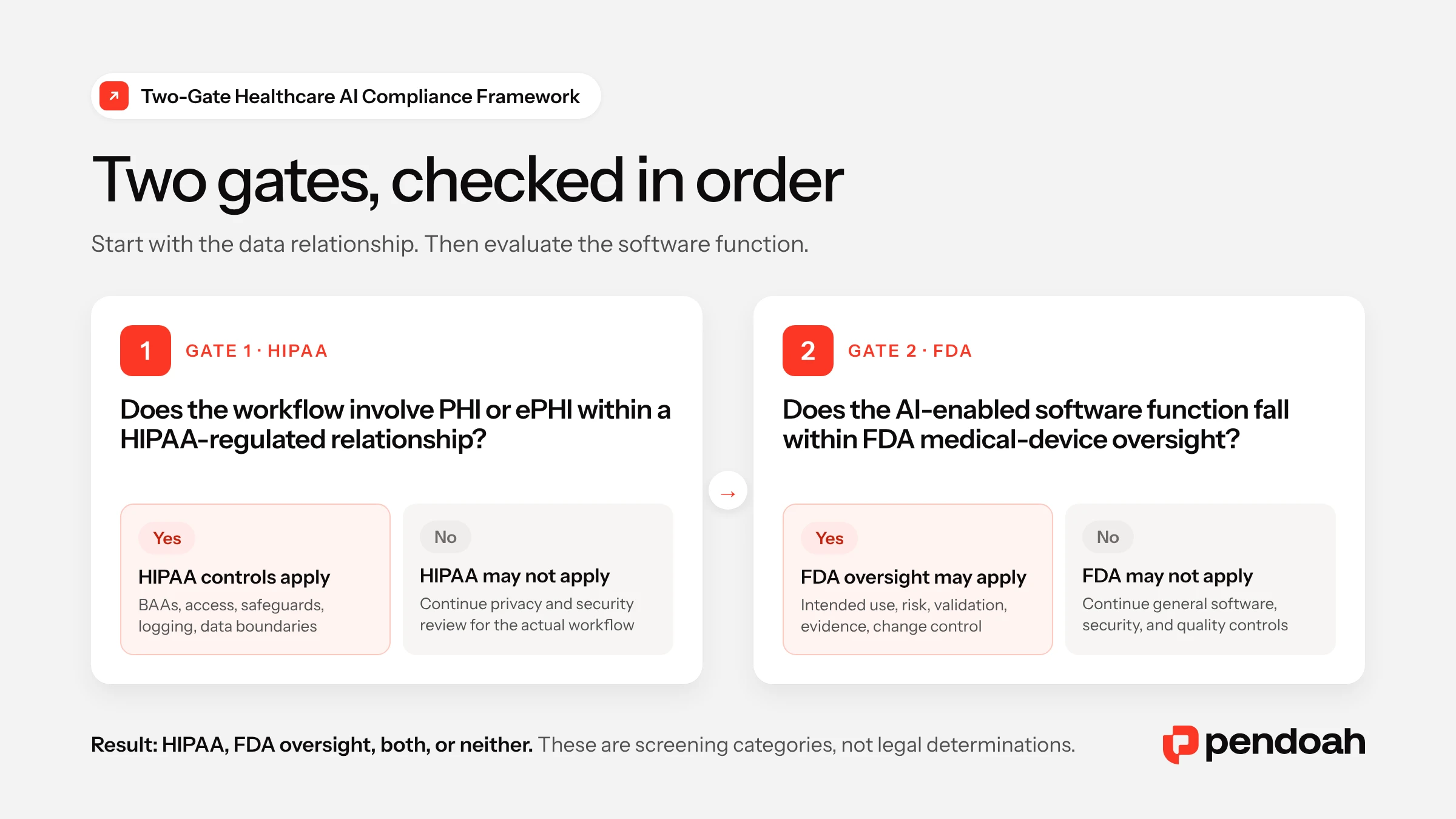
These categories are for screening, not legal determination. Their value is practical: they show engineering teams which regulatory questions to resolve before the product goes further.
What Compliance-First Delivery Changes in Practice
Compliance-by-design pays off when controls reduce delivery friction rather than adding another review layer. The two examples below come from regulated life-sciences validation and data access, not HIPAA or FDA device projects, but the operating principle carries over.
Pendoah’s work on ProVal AI combined AI-assisted validation with traceability, access controls, human review, and audit-defensible outputs for regulated medtech, pharmaceutical, and biotech workflows.
The project reported:
- 65% faster validation cycles
- 40% fewer review iterations
- 30% lower compliance costs
- 3x consultant capacity
StatSafe applied the same principle to pharmaceutical and life-sciences data access, combining AI-assisted querying with private-network deployment, SQL validation, audit logging, validation traces, and human-in-the-loop feedback. It reported 92% query accuracy and an 85% reduction in SQL support tickets.
Auditability, validation, and governance work better when they are designed into delivery rather than reconstructed before production.
Designed-in controls turn compliance from overhead into operating discipline. For the broader delivery case, see Pendoah’s Compliance-First AI guide on reducing retrofit work, approval friction, and late-stage compliance rework.
Gate 1: When Does HIPAA Affect AI Development?
A dataset containing medical information does not, by itself, trigger HIPAA. The relationship between the parties does.
Covered entities include health plans, health care clearinghouses, and qualifying health care providers. A business associate performs certain functions or services involving PHI on a covered entity’s behalf, and subcontractors join the HIPAA boundary when they create, receive, maintain, or transmit PHI for a business associate.
AI vendors make that structure more complex. A hospital might send data to an application platform that calls an AI service, while a transcription provider processes voice data, an observability platform captures logs, and a cloud service stores embeddings, files, prompts, or database records. The compliance boundary can reach well beyond the primary vendor.
A “HIPAA-ready” label on a technology doesn’t settle the architecture question. The organization still has to know where PHI travels, which entities touch it, what each may do with it, and which safeguards apply.
The HIPAA Security Rule groups its requirements into three kinds of safeguards: administrative (risk analysis, workforce policies, vendor management), physical (facility and device controls), and technical (access control, audit controls, integrity, and transmission security). Every AI component that handles ePHI inherits all three. The Breach Notification Rule applies as well: if PHI held by an AI component or vendor is breached, covered entities must notify affected individuals and HHS, and business associates must notify the covered entity.
What HIPAA Changes in the AI Architecture
Map the PHI boundary before deciding how a model will be connected, following the complete data path:
Source system → integration → preprocessing → model or AI service → application → logs → analytics → storage → backup
Each point is a potential exposure. A model gateway may send prompts to an external provider, application monitoring may record request payloads, and a vector database may retain extracted clinical content. Development environments sometimes hold copied production records, and support engineers may get broader access than their role needs.
The architecture should turn privacy and security requirements into concrete technical decisions:
| Development area | Practical control question |
|---|---|
| Data ingestion | Does the model need every field being transmitted? |
| Identity | Which users and services can access PHI? |
| Authorization | Are permissions mapped to roles and workflows? |
| AI requests | Which PHI elements enter prompts, model calls, or retrieval pipelines? |
| Storage | Where are prompts, outputs, embeddings, files, and logs retained? |
| Vendors | Which subprocessors create, receive, maintain, or transmit PHI? |
| Observability | Can logs accidentally persist sensitive information? |
| Development | Are engineers using production PHI outside approved environments? |
| Incident response | Can the team determine what data was accessed and by whom? |
When the architecture makes inappropriate data movement hard by design, compliance gets easier. The same discipline avoids costly later changes such as replacing an AI provider, rebuilding logging, moving data residency, renegotiating vendor terms, or redesigning permissions after a security review.
BAAs Are Necessary. Architecture Still Matters.
A signed BAA establishes contractual responsibilities for qualifying relationships, but it does not make an application compliant; the application still needs appropriate controls. AI development adds several vendor decisions that deserve explicit review:
- Model providers
- Vector databases
- Speech services
- Monitoring platforms
- Analytics tools
- Cloud storage
- Human support workflows
- Integration providers
Any of these can become part of the data path, so a compliance-first architecture documents that path before production traffic begins.
Rather than asking only whether a BAA exists, ask a stronger question:
Do our agreements, architecture, permissions, logging, vendor relationships, and operating practices describe the same controlled system?
That consistency matters most when responsibility is spread across several platforms.
De-Identification Can Change the Data Boundary
Not every AI workload needs identifiable patient data, and properly applied de-identification can move the data boundary considerably.
HIPAA recognizes two de-identification methods, Safe Harbor and Expert Determination, per HHS’s own de-identification guidance. The method chosen affects AI training, evaluation, analytics, and secondary data use.
Removing patient names is not de-identification. Free text, dates, geographic details, rare conditions, identifiers, and combinations of attributes can all still identify a person.
Data engineering teams should handle de-identification as a controlled transformation:
Input → method → validation → documented output → approved use
Documenting each step gives the organization evidence of what changed and why the resulting dataset suits the intended workflow.
Gate 2: When Does FDA Oversight Enter the Picture?
HIPAA largely defines the data-control problem; FDA oversight can change the product-development problem itself. Once an AI function serves a regulated medical purpose, intended use, validation, risk, human interaction, and change control become engineering requirements.
Healthcare software is not automatically a medical device. FDA’s approach is function-specific, so the intended function is what counts.
A product statement such as “AI assistant for healthcare” gives product, engineering, clinical, and regulatory teams too little to work with.
A usable definition identifies:
- Who uses the system
- What input it receives
- What output it produces
- Which decision the output supports
- Whether a human independently reviews the basis
- What happens if the output is wrong
These answers shape product requirements well before any submission question comes up.
If a function is a device, its risk and novelty determine the route to market. Most moderate-risk devices use 510(k) premarket notification, which shows substantial equivalence to a device already on the market. Novel low-to-moderate-risk devices with no predicate can use the De Novo pathway, and high-risk devices need premarket approval (PMA). Software that serves a medical purpose without being part of a hardware device is often called software as a medical device (SaMD), for example an algorithm that flags suspected stroke on imaging for a clinician to review.
Not Every Healthcare AI Function Is an FDA-Regulated Device
Healthcare AI functions vary widely. Some support administrative or operational work, some support patient self-management, some provide information to clinicians, and some analyze individual patients in ways that may influence diagnosis or treatment. Each carries a different regulatory profile.
Define the intended use before model development becomes expensive. The question to answer is:
What exact function does this software perform, for whom, and with what consequence if the output is wrong?
A precise answer supports regulatory analysis and better engineering at the same time.
Clinical Decision Support Needs Specific Attention
Clinical decision support (CDS) needs particular care. Placing a clinician between the model and the patient does not automatically remove FDA considerations; the exact software function still matters, and FDA’s Clinical Decision Support Software guidance sets out which CDS functions are excluded from device regulation and which remain devices.
AI that summarizes available information carries a different risk profile from software that analyzes an individual patient and recommends a diagnosis or treatment. Whether a healthcare professional can independently review the basis for a recommendation also affects how the function is evaluated.
FDA updated that guidance on January 6, 2026, replacing the September 2022 version. The update keeps the four statutory criteria but softens the agency’s position on CDS that offers a single recommendation, adds more worked examples, and puts more weight on transparency, so clinicians can understand the basis for an output. FDA updated its general wellness guidance the same day. Teams that scoped a CDS feature against the 2022 guidance should re-check it against the 2026 version.
Clinical AI also carries nondiscrimination duties. Under Section 1557 of the Affordable Care Act, covered entities have had to make reasonable efforts since May 1, 2025 to identify decision support tools, including AI, that use race, color, national origin, sex, age, or disability as inputs, and to mitigate the resulting risk of discrimination.
That makes interface design a regulatory issue. An interface that shows relevant source data, evidence, assumptions, or reasoning supports a very different review model from one that returns an unexplained label such as “High risk.”
The interface becomes part of governance, and human oversight has to be built into the workflow rather than added as a disclaimer, the principle behind Human in the Loop.
FDA Oversight Changes the Development Lifecycle
Once an AI-enabled software function falls under FDA device oversight, standard software delivery practices may not provide enough traceability. The engineering process needs continuous evidence linking each decision to its proof:
| Development decision | Evidence the organization should be able to produce |
|---|---|
| Intended use | Approved intended-use and user definition |
| Requirements | Traceable product and safety requirements |
| Dataset selection | Data provenance, inclusion criteria, and dataset rationale |
| Model development | Version, configuration, and training records |
| Validation | Defined metrics, test datasets, and results |
| Risk management | Documented hazards, controls, and residual risks |
| Human interaction | User workflow and review responsibilities |
| Cybersecurity | Threat analysis, controls, and relevant verification evidence |
| Release | Approved software and model versions |
| Change | Impact analysis and revalidation decision |
| Production | Monitoring, incidents, performance signals, and corrective actions |
Device developers also work under FDA’s Quality Management System Regulation (QMSR), which took effect on February 2, 2026 and brings ISO 13485:2016 into 21 CFR Part 820, so design controls, risk management, and change records have to live inside a compliant quality system. For AI specifically, FDA’s January 2025 draft guidance on AI-enabled device software functions lists the lifecycle documentation it expects in marketing submissions. The guidance is not final, but it shows what reviewers are likely to ask for.
Documentation is a means, not the goal. Traceability lets the organization answer one question:
Which evidence proves that this exact version of the system is suitable for its intended function?
A team that can’t answer it has an operating problem, and better paperwork alone won’t fix it.
AI Creates a Change-Control Problem
Traditional software changes often; AI adds more ways to change. A production AI system can shift because:
- The model changes
- Training data changes
- Retrieval sources change
- A prompt changes
- Thresholds move
- Preprocessing changes
- A third-party foundation model is upgraded
- A new patient population is introduced
After any of these changes, the interface may look the same while behavior differs, which makes AI change management a lifecycle discipline.
Predetermined Change Control Plans (PCCPs) offer one mechanism for handling certain planned modifications to AI-enabled device software functions, per FDA’s final PCCP guidance. Whether or not a PCCP applies, every change process needs to record:
What changed → why it changed → what was tested → what passed → who approved it → what reached production
This is the point where regulatory requirements and MLOps meet.
Healthcare MLOps Needs Regulatory Traceability
MLOps governs how models are developed, evaluated, deployed, monitored, and updated. Healthcare MLOps adds a further requirement:
Evidence continuity.
Evidence continuity distinguishes a model that was validated once from a production system that stays defensible as it changes. Layered Governance Architecture covers the audit-trail and access-control discipline behind it, and our AI governance framework guide covers the policy layer above. A useful production record connects:
Requirement → dataset → model version → validation → approval → deployment → monitoring → change
Without that chain, teams may not be able to reproduce why a model was approved or show which evidence applies to the version now running.
In practice, a production incident should identify the deployed model, the model should point to its validation, the validation should point to defined requirements, and each change should show whether revalidation was needed. Because AI keeps changing after launch, the evidence trail has to continue too.
Cybersecurity Is a Product-Lifecycle Requirement
A clinically useful model inside an insecure product is not a safe production system. Healthcare AI attack surfaces include:
- Authentication
- APIs
- Cloud infrastructure
- Model endpoints
- Retrieval systems
- Data pipelines
- Third-party dependencies
- Secrets
- Administrative interfaces
- Connected devices
Avoid running separate security programs for the model, the application, and the infrastructure. Identity, data protection, threat modeling, logging, vulnerability management, release controls, incident response, and monitoring should operate as one system, the governance-by-design principle in our AI Compliance guide.
HIPAA and FDA contexts differ, but their engineering controls often overlap, so cybersecurity should develop alongside the product instead of arriving as a final release gate.
The Compliance Evidence Package Should Grow With the Product
A common mistake is assembling evidence only when a customer security review, regulatory discussion, audit, or submission arrives. The result is costly reconstruction: engineers search old tickets, data scientists try to trace which dataset produced a model, product managers piece together why a threshold changed, and security teams find a key architecture decision buried in a six-month-old chat thread.
Capturing evidence during development avoids that. The package should tell one controlled story from business intent through production behavior, and a practical version can include:
- Requirements
- Architecture decisions
- Data lineage
- Vendor assessments
- Access-control decisions
- Security risk analysis
- Model versions
- Validation records
- Release approvals
- Change records
- Incident records
- Monitoring evidence
The exact contents depend on the product and the requirements that apply. The principle does not:
Evidence should be an output of the delivery process, not a reconstruction exercise at the end.
Beyond audits, a growing evidence package speeds internal review, simplifies handover, improves incident investigation, reduces dependence on individual team members, and gives executives a clearer view of what they are approving.
HIPAA and FDA Development Control Matrix
Although the two frameworks address different risks, their concerns overlap across several engineering areas.
| Development area | HIPAA concern | FDA concern |
|---|---|---|
| Data | PHI use, disclosure, access, and safeguards | Dataset suitability and evidence supporting device performance |
| Identity | Authorized access to ePHI | Safe and appropriate use of the software function |
| Architecture | PHI boundaries, vendors, and security | System design supporting intended use and safety |
| Model | Potential exposure of PHI | Performance for the intended function |
| Testing | Security and privacy controls | Verification, validation, safety, and effectiveness evidence |
| Logging | Security accountability and investigation | Traceability and production evidence |
| Changes | Updated risk and security considerations | Change assessment, validation, and possible regulatory impact |
| Production | Incident detection and response | Ongoing safety, cybersecurity, and product performance |
The overlap explains why a final compliance review usually comes too late. By then, data architecture may be embedded in integrations, model behavior tied to a clinical workflow, vendor contracts signed, and validation datasets chosen. Compliance architecture has to come in before those commitments harden.
Common Healthcare AI Compliance Failures
Choosing the AI provider before mapping PHI
Teams discover later that data routing, retention, vendor terms, deployment options, or subcontractors don’t fit the intended workflow.
Treating a BAA as proof of application compliance
Contracts matter, but technical safeguards, access models, risk analysis, configuration, logging, and operational practices still have to work.
Defining FDA scope after the product is built
Intended use should guide requirements and evidence from the start.
Using clinical data without a documented data path
Teams need to know where the data came from, how it is controlled, why it is used, and how it connects to model validation.
Losing the link between model versions and test evidence
A validation result only counts when the organization knows which system version it supports.
Treating model changes like routine application patches
A change to a model, dataset, prompt, retrieval source, or decision threshold can alter behavior with no visible change to the interface.
Logging sensitive data indiscriminately
Observability should strengthen accountability without creating unnecessary copies of PHI.
Waiting until launch to design monitoring
Monitoring should be designed around known safety, performance, security, and compliance risks before release.
The Pendoah Compliance-First AI Delivery Framework
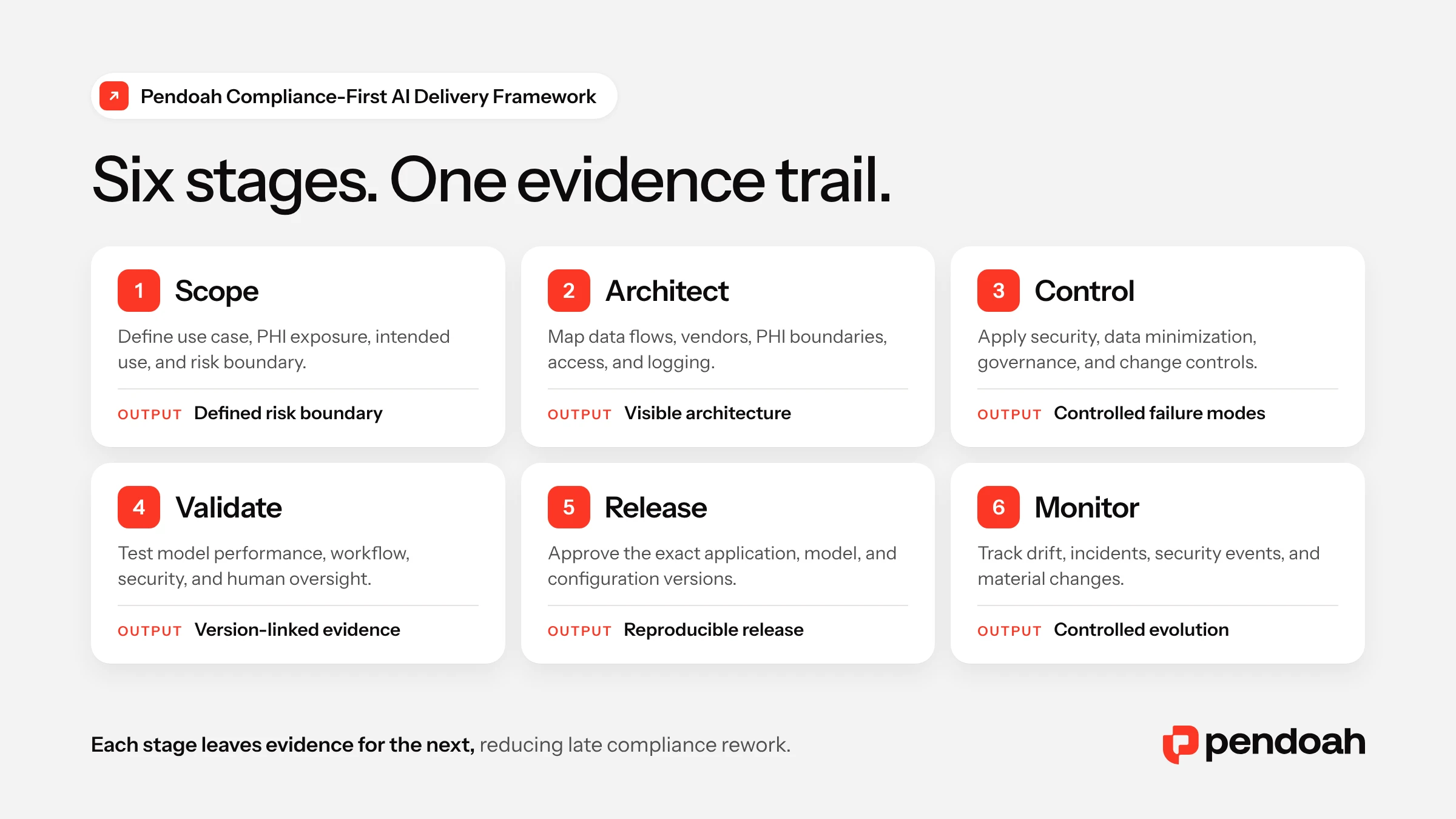
Pendoah connects regulatory questions to engineering work through six stages:
Scope → Architect → Control → Validate → Release → Monitor
1. Scope
Define what the AI does before selecting the technology.
- User
- Workflow
- Intended outcome
- PHI exposure
- Clinical role
- Failure consequences
- Regulatory assumptions
- Human oversight
Output: a defined operating and risk boundary.
2. Architect
Map every system, vendor, data store, model service, and user touching the workflow.
- PHI boundaries
- Trust boundaries
- Data flows
- External vendors
- Authentication
- Authorization
- Retention
- Logging
- Integration dependencies
Output: an architecture where regulatory assumptions are visible.
3. Control
Translate identified risks into technical and operational controls.
- Least-privilege access
- Encryption
- Data minimization
- Audit logging
- Human escalation
- Dependency governance
- Vendor controls
- Change approval
- Incident response
Output: a system designed to contain predictable failure modes.
4. Validate
Test the system against the claims that matter.
- Software requirements
- Model performance
- Clinical workflow
- Security controls
- Human interaction
- Failure recovery
- Subgroup performance
- Integration behavior
Output: evidence tied to a specific system version.
5. Release
Production should receive an approved configuration, not whichever build passed the last demo.
- Application version
- Model version
- Prompt or configuration version
- Infrastructure version
- Approval
- Rollback path
- Release evidence
Output: a reproducible production state.
6. Monitor
The compliance process continues after launch.
- Model performance
- Errors
- Security events
- Data drift
- Workflow failures
- Human escalations
- Dependency changes
- Material product changes
Output: controlled evolution.
Each stage keeps compliance close to the work that creates the risk. Legal, regulatory, clinical, product, security, data, and engineering teams keep their distinct responsibilities but share one evidence trail.
Questions Leaders Should Answer Before Development Starts
Before approving a healthcare AI build, a CTO, CIO, head of AI, clinical leader, product executive, or security leader should be able to answer:
- Which exact workflow will the AI influence?
- Will the system create, receive, maintain, or transmit PHI?
- Which covered entities, business associates, subcontractors, and vendors participate in the workflow?
- Which data actually needs to reach the AI component?
- What is the intended clinical or operational function?
- Could the software function fall within FDA device oversight?
- Which failure would create the greatest patient, privacy, security, or operational risk?
- What evidence will determine whether the system is ready for production?
- How will model, data, prompt, retrieval, and configuration changes be controlled?
- Who owns monitoring and regulatory reassessment after launch?
Unclear answers don’t necessarily mean the project should stop, but they do suggest it’s too early to choose the architecture.
Where Pendoah’s Approach Is Different
Pendoah treats AI engineering and the controls needed to operate it as one production system: product requirements, PHI boundaries, data engineering, model behavior, security, validation, human oversight, deployment, and monitoring.
Pendoah’s AI Development Services run model engineering, data architecture, security, validation, and production operations through one delivery path. If you’re still deciding whether to buy a platform or build one, see our build vs. buy guide.
In regulated AI, a technically strong model can still fail if the organization cannot explain:
- Where its data came from
- Which version was validated
- Who approved a change
- Which controls protect production access
- What happens when performance moves outside an accepted range
The aim is the right amount of control, not more governance:
Enough control to keep the system moving safely.
Our Agents at Scale guide applies the same principle to autonomous systems: architecture, security, observability, validation, and ownership designed together from use case to production.
Compliance Should Make Healthcare AI Easier to Operate
Models, data sources, clinical workflows, security expectations, and regulatory guidance will all keep changing. Successful healthcare AI teams won’t prevent change; they will be able to show:
- What changed
- Why it changed
- Which evidence still applies
- What was revalidated
- Who approved the release
- How production behavior is being monitored
That is the purpose of compliance-first AI development. HIPAA sets clear boundaries around health data, FDA oversight (where it applies) sets expectations for intended use, evidence, safety, and lifecycle control, and strong engineering connects both to the system running in production. The organization can then update its AI without re-establishing its risk position each time.
Ready to map the regulatory, data, and validation requirements for your healthcare AI build? Book a consultation with Pendoah, or see how other clients approached it in our case studies.